

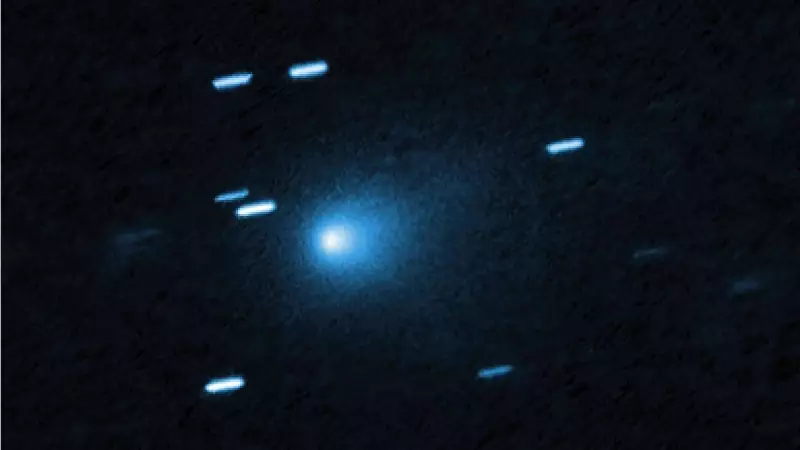
A rare and fleeting cosmic visitor is making its final curtain call in our celestial neighborhood. The interstellar comet known as 3I/ATLAS is set to make its closest approach to Earth this week, offering astronomers and skywatchers a last, precious opportunity to study it before it departs our solar system forever. This object, which originated from the depths of interstellar space, will not return, making its current passage a unique and historic event for the global astronomical community.
A Final Farewell from the Stars
According to detailed reports, the comet's closest approach to our planet is scheduled for December 18, 2025. On this date, the interstellar wanderer will come within approximately 113 million kilometers of Earth. To put this distance in perspective, that is roughly 75% of the distance between Earth and the Sun. While this is a safe and distant pass, it is close enough for powerful telescopes to gather significant data.
The comet was first discovered by the Asteroid Terrestrial-impact Last Alert System (ATLAS) survey, earning its official designation 3I/ATLAS. The '3I' is particularly significant, as it denotes that this is only the third interstellar object ever confirmed to be passing through our solar system, following the famous 'Oumuamua in 2017 and comet 2I/Borisov in 2019. Its detection has been a monumental achievement for astronomers, providing a tangible piece of material from another star system for study.

Scientific Significance of the Interstellar Visitor
The impending departure of 3I/ATLAS adds urgency to ongoing observation campaigns. Scientists across the globe, including those at Indian observatories, are directing their instruments toward the comet to capture as much information as possible. The primary goals of these observations are multifaceted and critically important for our understanding of the cosmos.
Researchers are intensely analyzing the comet's composition. By studying the light reflected from its nucleus and coma—the cloud of gas and dust surrounding it—spectrographs can determine what molecules and minerals are present. This data acts as a chemical fingerprint, revealing the building blocks of the alien star system from which the comet originated. Key questions scientists hope to answer include:
- How does the composition of 3I/ATLAS compare to comets native to our solar system?
- What can its structure tell us about planet formation processes around other stars?
- Does it carry pristine material unchanged since the dawn of its home system?
Furthermore, tracking its trajectory with extreme precision helps astronomers confirm its hyperbolic orbit. This is the path that proves the comet is not bound by the Sun's gravity and is merely passing through. Each measurement refines our models of interstellar object dynamics and their interactions with our solar system.
A Once-in-a-Lifetime Astronomical Event
For amateur astronomers and the public, the event carries a profound sense of wonder, though a note of realism is required. The comet is not visible to the naked eye or through standard binoculars. Its brightness, or magnitude, is expected to remain around +19 to +20 during its closest approach, which is far too faint for casual observation. Viewing this historic departure requires access to substantial professional telescopes.
However, observatories and space agencies may release images and data to the public in the coming days. The event underscores the rapid advancement of sky-survey technology like ATLAS, which is designed to detect potentially hazardous asteroids but has proven invaluable for discovering these rare interstellar travelers. Its success hints that such visitors may be more common than previously thought, and future surveys will likely find more.
As 3I/ATLAS completes its swing around the Sun and begins its endless journey back into the void between stars, it leaves behind a treasure trove of data. This week's closest approach marks the end of a short but scientifically rich chapter in astronomy. The comet's legacy will be the knowledge it imparts, helping to unravel the mysteries of planetary systems far beyond our own and reminding us of the dynamic and interconnected nature of our galaxy.






