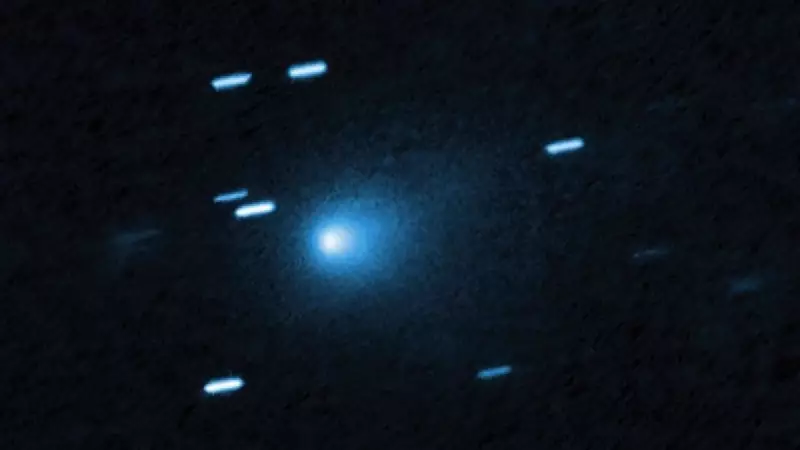
As it journeys back into the depths of interstellar space, the rare comet 3I/ATLAS continues to challenge scientific understanding, revealing bizarre behaviours never before seen in a visitor from beyond our solar system. Fresh observations have uncovered strange, wobbling jet structures within an unusual sun-pointing tail, providing a one-of-a-kind look at pristine material formed around another star.
The Puzzling Sunward Tail and Its Shifting Jets
Comets are famous for their spectacular tails of gas and dust, which are pushed away from the Sun by solar radiation. However, astronomers focusing on 3I/ATLAS observed a rare phenomenon known as an anti-tail—a feature that appears to point towards the Sun. This structure is typically uncommon and short-lived.
Within this sun-facing tail, researchers detected jet-like formations that did not stay in a fixed position. Instead, they exhibited a slow, rhythmic wobble, shifting over time. On some occasions, this anti-tail stretched to an impressive length of roughly 1 million kilometres (about 620,000 miles), making it a surprisingly prominent feature for such a distant object.

A Rare Interstellar Visitor Under the Microscope
The discovery holds exceptional significance due to the comet's origin. 3I/ATLAS is only the third confirmed interstellar object to enter our solar system, following the mysterious 'Oumuamua in 2017 and comet 2I/Borisov in 2019. While solar system comets have shown anti-tails and variable jets, this marks the first time such outgassing behaviour has been documented in an interstellar visitor.
"Characterising jets in 3I thus represents a rare opportunity to investigate the physical behaviour of a pristine body formed in another planetary system," stated the research team in their paper.
Months of Observation Reveal a Spinning Core
The findings are the result of an intensive 37-night observation campaign conducted between July 2 and September 5, 2025, using the Two-meter Twin Telescope (TTT) at the Teide Observatory in Tenerife, Spain. As the comet neared the Sun, its appearance evolved from a fan-shaped dust coma into a more defined anti-tail.
The intermittent jets were spotted on seven separate nights between August 3 and August 29. Detailed analysis showed they were not merely flickering but displayed a clear precessional motion, wobbling with a regular period of about 7 hours and 45 minutes.
From this pattern, scientists deduced a crucial property of the comet: its nucleus completes one full rotation approximately every 15 hours and 30 minutes. This spin period, shorter than previous estimates, means the comet's icy core rotates fast enough to move its active regions in and out of sunlight, causing the observed jet changes.
A Legacy for Future Interstellar Studies
3I/ATLAS made its closest approach to the Sun on October 30, 2025, coming within about 210 million km (130 million miles). It later passed closest to Earth on December 19, 2025, at a distance of roughly 270 million km (168 million miles) before beginning its long voyage out of the solar system.
Like its interstellar predecessors, it will eventually escape the Sun's gravity and vanish into the galaxy. Yet, its scientific impact is enduring. By exposing unexpected jet activity within a sun-facing tail, 3I/ATLAS has granted astronomers a precious window into the mechanics of small, icy worlds born around other stars. The clues it has left behind will undoubtedly influence the study of interstellar visitors for decades.