

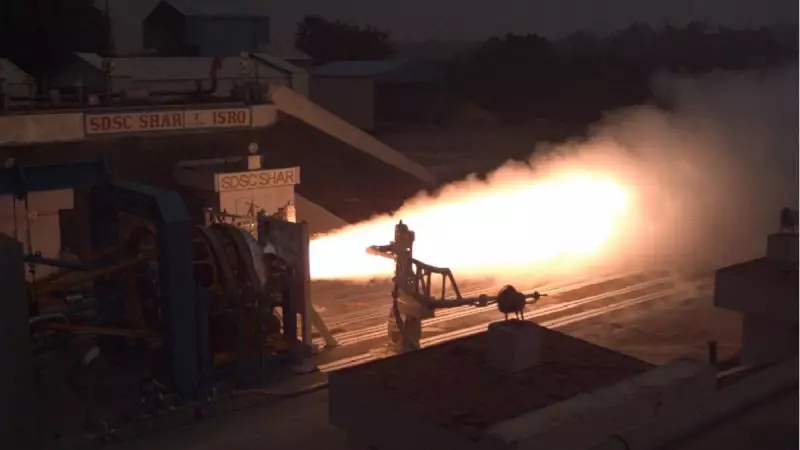
The Indian Space Research Organisation (ISRO) has taken a significant stride forward in its small satellite launch vehicle program. On Tuesday, December 31, 2024, the space agency announced the successful completion of a crucial static test for the improved third stage of the Small Satellite Launch Vehicle (SSLV).
A Major Milestone for Launch Reliability
The test was conducted at the ISRO Propulsion Complex (IPRC) in Mahendragiri, Tamil Nadu. This static fire test is a ground-based procedure where the rocket motor is firmly held in place and ignited to verify its performance and structural integrity under flight-like conditions without actually taking off. The successful test validates key design upgrades intended to enhance the overall reliability and performance consistency of the SSLV's third stage, officially named the Altitude Truncated Apex Motor (ATAM).
According to ISRO's official statement, the test met all its predetermined objectives. Engineers monitored a comprehensive set of parameters during the firing to ensure the motor's behavior aligned with predictions. This successful validation is a critical step before the upgraded stage can be integrated into future launch vehicles.

Addressing Past Challenges and Enhancing Performance
The development of the SSLV has been a strategic focus for ISRO, aiming to provide a dedicated, cost-effective, and responsive launch solution for small satellites. However, the vehicle's developmental journey has included learning experiences. The most recent SSLV mission, SSLV-D3, launched in February 2024, faced an issue where the satellites were injected into a lower-than-intended orbit due to a third-stage sensor anomaly.
The upgrades tested on December 31 directly address such past technical challenges. The improvements to the ATAM stage focus on making the system more robust and fault-tolerant, thereby increasing the mission success probability for future launches. This proactive approach to refining the vehicle based on flight data underscores ISRO's commitment to creating a highly reliable workhorse for the global small satellite market.
What This Means for India's Space Ambitions
The successful static test marks a pivotal moment for the SSLV program. With this key hurdle cleared, ISRO can proceed with integrating the improved third stage into the next flight vehicle. This paves the way for the upcoming SSLV-D4 mission, which is expected to launch later in 2025.
The enhanced SSLV is poised to strengthen India's position in the competitive commercial small satellite launch sector. Its ability to offer quick turnaround times and dedicated rides for micro, nano, and small satellites makes it an attractive option for private companies, academic institutions, and other space agencies. Furthermore, a reliable SSLV provides ISRO with greater flexibility for launching its own earth observation and scientific satellites on demand.
The test was a collaborative effort led by the Vikram Sarabhai Space Centre (VSSC) in Thiruvananthapuram, which is the lead center for the design and development of the launch vehicle. The Liquid Propulsion Systems Centre (LPSC) and the Satish Dhawan Space Centre (SDSC) SHAR also played vital roles in the propulsion and launch infrastructure aspects, respectively.
This achievement reinforces ISRO's consistent strategy of meticulous testing and incremental improvement. By successfully validating the upgraded third stage on the ground, the agency has significantly de-risked the next phase of the SSLV's operational journey, bringing India closer to having a fully operational and dependable small satellite launch capability.






