In a groundbreaking discovery with far-reaching implications for India's space ambitions, the Indian Space Research Organisation (ISRO) has confirmed that Earth's atmosphere is constantly bombarded by microscopic particles from deep space. Data from a novel instrument reveals that an interplanetary dust particle enters our planet's atmospheric shield approximately every 1,000 seconds, or roughly once every 16 minutes.
The DEX Instrument and Its Maiden Discovery
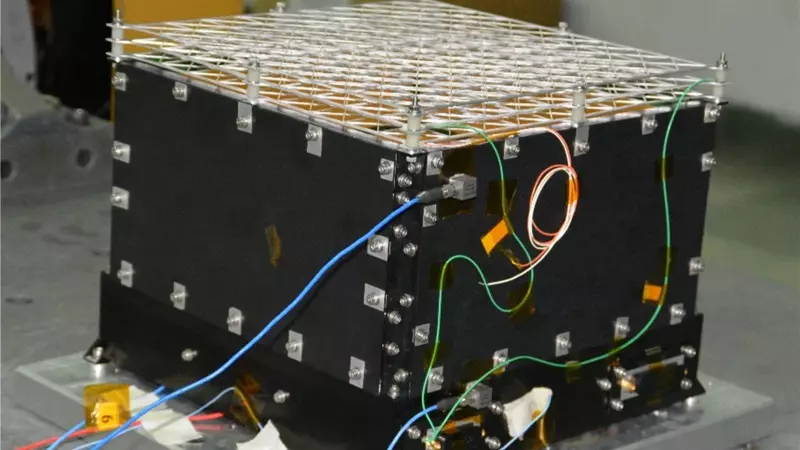
The critical findings come from the Dust EXperiment (DEX), a unique 3-kilogram instrument developed by the Physical Research Laboratory (PRL). DEX was launched into orbit as part of the XPoSat mission on January 1, 2024. ISRO announced the results of its maiden experiment on Monday, January 7, 2026.
Designed as a first-of-its-kind detector for high-transient particles, DEX performed experimental tests in early 2024. Its wide-view detector, with a 140-degree field of vision, successfully logged signals of impacts from orbital debris between January 1 and 9, 2024. While skimming the atmosphere at a 9.5-degree inclination, the detector registered several hits, providing the first direct measurement of this constant cosmic influx.

Why Studying Space Dust is Critical for Safety and Science
Earth's atmosphere isn't just composed of gases; it also contains suspended solid particles, or dust, originating from comets, meteors, asteroids, and other celestial bodies. While gases are essential for life, this interplanetary dust poses a significant threat. These particles are classified as dangerous because they can interfere with and damage spacecraft and satellites.
Interplanetary dust directly affects the quality of the space environment and influences space weather, which in turn can impact Earth. A hypervelocity impact from a dust particle or larger piece of space debris can have consequences ranging from minor surface dents to catastrophic mission failure, including the complete deorbiting of a satellite. Projectiles traveling faster than 4 km per second can disintegrate or melt upon impact, posing a severe risk.
During its experiment, DEX measured a dust flux—the rate at which dust travels—of up to 6.5 × 10⁻³ per square meter per second. This reasonably high rate confirms the theory of constant particle bombardment. The instrument itself operates on the hypervelocity impact principle, capturing data on high-speed dust impacts using a minimal 4.5 Watts of power.
Paving the Way for Gaganyaan and Planetary Exploration
This research is not just academic; it has immediate and future practical applications for India's space program. The data on interplanetary dust will be invaluable for planning the Gaganyaan manned spaceflight missions. Understanding the particulate environment in Earth's orbit and beyond is crucial for astronaut safety and spacecraft durability.
Furthermore, as India sets its sights on missions to the Moon, Venus, and Mars, instruments based on the DEX technology will become essential. They will be deployed to study the atmospheric composition of these celestial bodies. Analyzing dust in the atmospheres of Mars and Venus could unlock secrets about their climate history, geological activity, and potential for past habitability.
Ultimately, the detection and measurement of space dust add immense value to tracking space weather and monitoring the space environment. This has direct links to protecting critical space assets, including communication and navigation satellites, as well as space telescopes, securing India's investments and capabilities in the final frontier.