

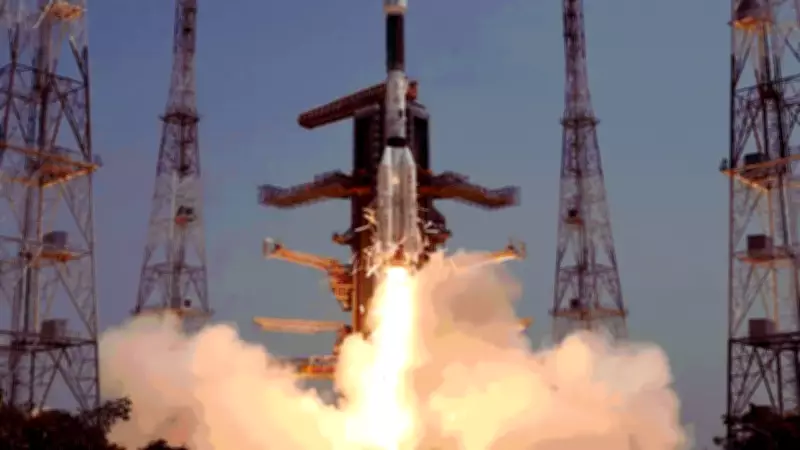
ISRO Scientists Pinpoint Moon Landing Site for Chandrayaan-4 Sample Return Mission
Scientists from the Indian Space Research Organisation's Space Applications Centre have identified a promising landing zone in the rugged south polar region of the Moon for India's first lunar sample return mission, Chandrayaan-4. This groundbreaking discovery marks a significant step forward in India's ambitious planetary exploration program.
Detailed Terrain Analysis Using Chandrayaan-2 Data
A comprehensive terrain study utilizing images from the Chandrayaan-2 Orbiter High Resolution Camera has shortlisted a one-square-kilometre patch near Mons Mouton as the safest option for touchdown. The research team, consisting of Amitabh, K Suresh, Ajay K Prashar, Kannan V Iyer, Abdul S, Shweta Verma Trivedi and Nitant Dube, conducted this meticulous analysis to identify the optimal landing location.
Chandrayaan-4 represents ISRO's most complex lunar mission to date. The spacecraft will feature multiple modules including:

- A propulsion module
- A descender module
- An ascender module
- A transfer module
- A re-entry module
The descender and ascender stack must execute a soft landing on the lunar surface, collect valuable samples, and launch them back to lunar orbit for eventual return to Earth.
Critical Landing Site Requirements
Selecting the appropriate landing site is absolutely crucial for mission success. Engineers must ensure several critical conditions are met:
- Gentle local slopes within acceptable parameters
- Adequate sunlight exposure for at least 11-12 days
- Clear radio visibility to Earth for communication
- Minimal hazards including craters and boulders
The lander design imposes specific constraints, limiting acceptable slopes to approximately 10° and requiring boulders smaller than 0.32 metres. Earlier assessments based on coarser data had highlighted several candidate areas between 84° and 90° south latitude, but the new research focused specifically on five zones around Mons Mouton.
Advanced Analysis with High-Resolution Imaging
Researchers employed sharper OHRC stereo images at 32-centimetre resolution to conduct their detailed analysis. One potential site was immediately discarded because it lay in permanent shadow, making it unsuitable for solar-powered operations.
The scientific team generated digital elevation models at an exceptionally fine grid of 0.32 metres and meticulously studied terrain undulations, illumination patterns, and hazard distribution across the candidate areas. Four specific locations, labelled MM-1, MM-3, MM-4 and MM-5, were compared across multiple parameters including mean slope, height range, and the number of safe landing grids measuring 24 by 24 metres.
The Optimal Landing Site Emerges
Among all evaluated locations, the MM-4 area emerged as the clear front-runner. Positioned at latitude minus 84.289° and longitude 32.808°, this site demonstrated the lowest hazard level at just 9.89%, an average slope of 5°, and the highest count of 568 safe landing grids. The region also offered favourable illumination conditions and limited shadowing from nearby terrain features.
Other candidate sites presented significantly higher risks. MM-1 and MM-3 recorded hazard levels exceeding 12%, while MM-5 provided only 72 safe grids within the target area. Elevations across these sites ranged from 4,800 to over 6,100 metres, reflecting the broken and challenging topography characteristic of the lunar south pole region.
Technological Advancements Enable Precision Planning
Scientists emphasize that this analysis demonstrates how high-resolution imaging technology can guide precise landing decisions for complex space missions. The OHRC data allowed researchers to map craters, boulders, and slopes with unprecedented clarity not available during earlier lunar missions.
If officially approved by the landing site selection committee, the MM-4 patch will host India's historic first attempt to retrieve and return lunar samples to Earth. Successful completion of this mission would position ISRO among an elite group of space agencies capable of returning extraterrestrial samples, opening an entirely new chapter in India's planetary exploration capabilities and scientific achievements.






