

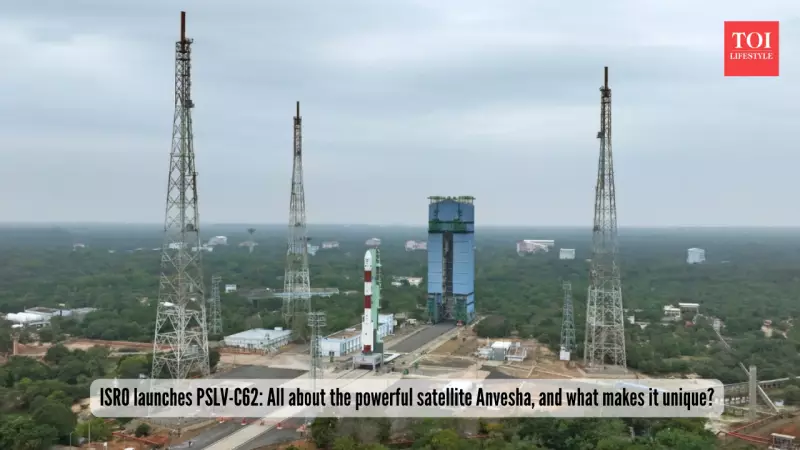
In a significant start to its 2026 launch calendar, the Indian Space Research Organisation (ISRO) successfully launched the PSLV-C62 mission from the Satish Dhawan Space Centre in Sriharikota today. The rocket lifted off precisely at 10:17 am, carrying the sophisticated EOS-N1 satellite, also named Anvesha, a powerful Earth-observation platform designed to significantly boost India's surveillance and monitoring prowess from space.
The PSLV-C62 Mission and Its Strategic Payload
Marking the 64th flight of the reliable Polar Satellite Launch Vehicle (PSLV), this mission featured the rocket in its DL configuration with two strap-on boosters. The 260-tonne workhorse delivered its primary passenger, the Anvesha satellite, into a polar sun-synchronous orbit at an altitude of 200-400 kilometers. The PSLV, with a legacy that includes historic missions like Chandrayaan-1 and the Mars Orbiter Mission, continues to be a cornerstone of India's space program.
The star of the mission, Anvesha (EOS-N1), is a state-of-the-art hyperspectral Earth observation satellite built for the Defence Research and Development Organisation (DRDO). Unlike conventional imaging satellites, Anvesha's advanced sensors capture data across hundreds of narrow spectral bands of light, far beyond the visible spectrum. This capability allows it to perform material identification and analysis from space, offering applications in border security, coastal monitoring, agriculture, urban planning, and environmental studies.

Anvesha: The Satellite That Sees Through Disguises
Space analyst Girish Linganna explained the satellite's unique advantage to The Week. He stated that objects like enemy tanks hidden under camouflage nets, illegal activities concealed by vegetation, or crops suffering from disease that appear healthy to normal cameras can be detected by Anvesha. This is because different materials reflect light in unique, subtle ways that are invisible to regular cameras but are clearly discernible to hyperspectral sensors.
Echoing this sentiment, Lt General AK Bhat (Retd), Director General of the Indian Space Association (ISpA), highlighted the breakthrough nature of this technology in a statement to The Hindu. He emphasized that hyperspectral imaging surpasses conventional RGB imaging, delivering "unprecedented capabilities for material identification, strategic surveillance and national security, including applications in missile defence monitoring."
Launch Sequence and Anomaly Analysis
The launch sequence proceeded smoothly for the majority of the flight. Approximately 18 minutes after liftoff, the rocket successfully injected the Anvesha satellite into its intended orbit. The mission also served as a rideshare opportunity, deploying 15 smaller satellites from Indian and international clients, including seven from Hyderabad-based Dhruva Space, showcasing the growing role of India's private space sector.
However, ISRO Chairperson V Narayanan reported an anomaly during the final stages of the flight. "Performance of the vehicle up to the end of the 3rd stage was as expected, then we saw more disturbance in the vehicle's roll rates. Subsequently, there was a deviation observed in the flight path. We are analysing the data, and we shall come back at the earliest," he stated regarding the PSLV-C62 / EOS-N1 mission. Despite this, the primary objective of deploying Anvesha was accomplished successfully.
This launch firmly establishes India's advanced capabilities in space-based reconnaissance and Earth observation. The induction of Anvesha into orbit provides the nation with a powerful strategic tool, enhancing situational awareness and supporting a wide range of civilian and defence applications with its cutting-edge hyperspectral imaging technology.






