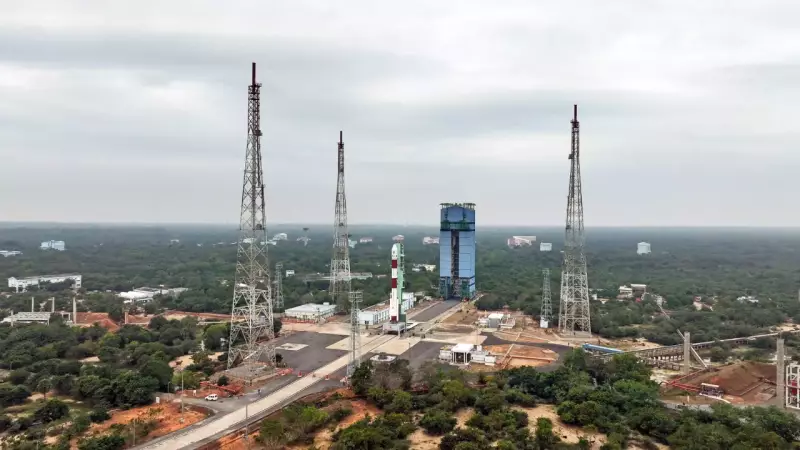
The Indian Space Research Organisation (ISRO) successfully kicked off its 2026 launch calendar with the precise lift-off of the PSLV-C62 mission from the Satish Dhawan Space Centre in Sriharikota at 10:17 am IST on January 12. This landmark flight, the 64th for the trusted Polar Satellite Launch Vehicle (PSLV), was executed by NewSpace India Limited (NSIL) as a dedicated commercial mission.
Primary Payload: A Strategic Eye in the Sky
The star of the mission was the primary payload, EOS-N1, codenamed 'Anvesha'. This advanced hyperspectral imaging satellite, developed by the Defence Research and Development Organisation (DRDO), is engineered to observe Earth across hundreds of distinct wavelengths. This capability allows for the precise identification of materials and objects on the ground, far beyond the scope of conventional optical satellites.
The satellite is poised to significantly bolster India's national security infrastructure by providing high-resolution intelligence for border monitoring, strategic mapping, and surveillance. Beyond defense, its data will be invaluable for civilian applications including agricultural assessment, urban planning, and environmental conservation.

A Constellation of Co-Passengers and Tech Demos
The PSLV-C62 mission was notable for its diverse set of 18 secondary payloads, highlighting the collaborative and innovative spirit of the global space community. A key international payload was the Kestrel Initial Demonstrator (KID) from Europe, a technology demonstrator that will test the experimental re-entry of a small capsule, culminating in a planned splashdown in the South Pacific Ocean in collaboration with a Spanish startup.
The mission underscored the vibrant growth of India's private space sector. Hyderabad-based Dhruva Space contributed seven satellites, a major milestone for commercial participation. Several other Indian startups and academic institutions had their payloads on board, including satellites from Space Kidz India, CV Raman Global University, Assam Don Bosco University, Akshath Aerospace, and Dayanand Sagar University.
Historic Test: On-Orbit Refuelling
One of the most technologically significant experiments on this flight was conducted by OrbitAID's 'AayulSAT'. This satellite will demonstrate India's first-ever on-orbit satellite refuelling capability. Success in this area would place India among a very select group of nations, like China, mastering this critical technology for extending satellite lifespans and enabling complex orbital operations.
Following the deployment of the EOS-N1 and 14 other satellites into a Sun-Synchronous Orbit, the PS4 upper stage of the rocket was restarted for a de-orbit manoeuvre. The KID re-entry capsule was then separated post this burn, setting the stage for its experimental return to Earth.
This multi-faceted mission not only advances India's strategic and observational capabilities but also firmly establishes the role of its commercial space entities, paving the way for a more robust and diversified space economy in the years to come.