

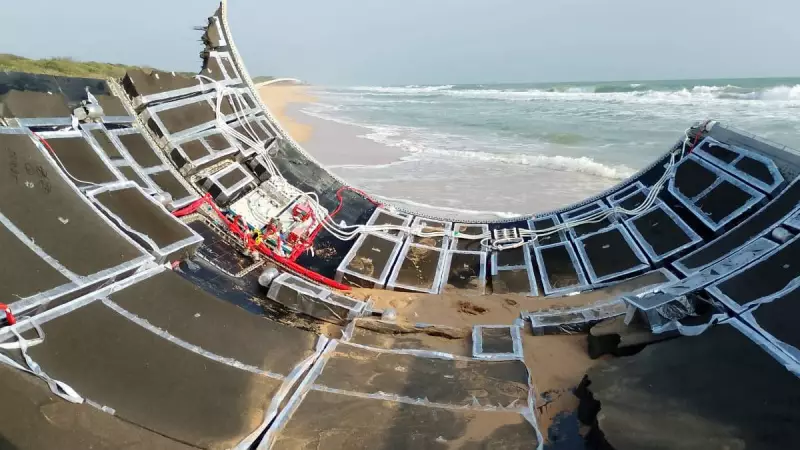
A significant piece of suspected space debris, believed to be from an Indian Space Research Organisation (ISRO) rocket, has been discovered on the coast of Sri Lanka. The large metal object washed ashore, prompting a local investigation and raising questions about the origin and safety implications of such finds.
Discovery and Initial Response
The mysterious object was found on a beach in Sri Lanka on December 30, 2024. Local fishermen were reportedly the first to spot the massive, cylindrical metal structure. Images from the scene show a large, rust-colored tank-like component partially buried in the sand, attracting the attention of both residents and authorities.
Sri Lankan police and maritime officials swiftly cordoned off the area to ensure public safety. Preliminary examinations suggested the object was not an explosive device but a part of aerospace hardware. Given its size and appearance, suspicion immediately turned towards it being a spent stage from a rocket launch vehicle.

Linking the Debris to ISRO's PSLV Mission
Initial analysis by Sri Lankan authorities and subsequent coordination with Indian officials point towards the debris originating from an ISRO Polar Satellite Launch Vehicle (PSLV). The object is suspected to be a part of the rocket's spent upper stage or a fuel tank.
This discovery follows a standard procedure for spent rocket stages, which are often jettisoned during flight and are designed to fall back to Earth in pre-determined zones, typically over uninhabited areas like open oceans. However, ocean currents can sometimes carry such debris far from its intended splashdown point.
The Indian Space Research Organisation has been notified and is expected to collaborate with Sri Lankan authorities to confirm the object's identity. Such events, while rare, highlight the complex challenges of managing space debris and ensuring the safety of maritime routes and coastal communities.
Implications and Ongoing Investigation
The incident underscores the growing issue of space debris re-entering Earth's atmosphere and landing in unexpected locations. While most components burn up upon re-entry, larger, denser parts like fuel tanks or engine components can survive the descent.
Authorities in both nations are now focused on several key steps:
- Formal Identification: A technical team will examine the debris to conclusively determine its origin and which specific mission it belonged to.
- Safety Protocol: Ensuring the object is inert and poses no chemical or environmental hazard to the local ecosystem.
- Diplomatic Coordination: Managing the retrieval and disposal process through proper diplomatic and technical channels between India and Sri Lanka.
This event serves as a reminder of the international nature of space exploration and the shared responsibility for managing its byproducts. It also highlights the need for robust tracking and prediction models for debris re-entry to better alert potentially affected regions. The investigation remains ongoing as officials work to secure and analyze the object.






