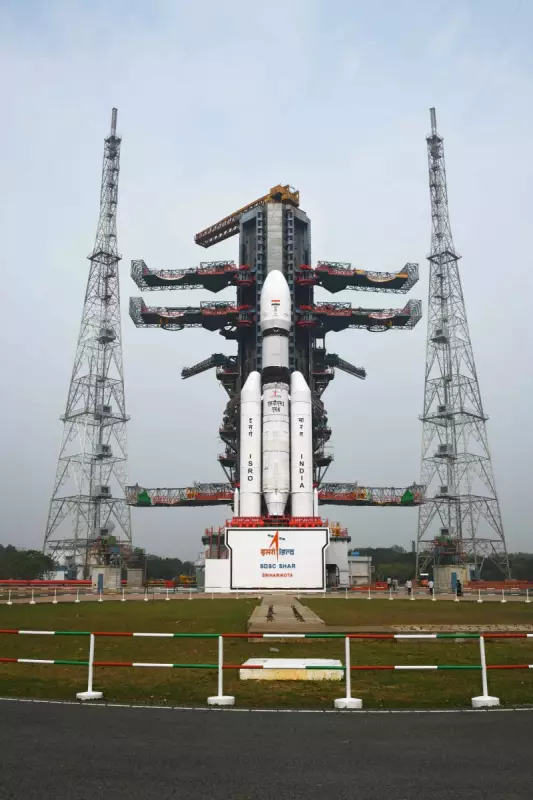
The Indian Space Research Organisation (ISRO) has taken a significant leap forward with the flawless launch of its Geosynchronous Satellite Launch Vehicle, the GSLV-F14. This mission stands out for carrying the heaviest payload ever lofted by an Indian rocket into space, setting a new national record.
A Perfect Launch from Sriharikota
On Saturday, February 17, 2024, at precisely 5:35 pm, the skies over Sriharikota roared to life as the GSLV rocket lifted off from the Satish Dhawan Space Centre. The mission's primary objective was to deploy the advanced INSAT-3DS meteorological satellite into a precise Geosynchronous Transfer Orbit (GTO). ISRO Chairman S. Somanath confirmed the mission's success shortly after launch, announcing that the satellite had been accurately placed into its intended orbit.
The INSAT-3DS: A Guardian for Weather Forecasting
The star of this mission, the INSAT-3DS satellite, is a crucial asset for India. Funded entirely by the Ministry of Earth Sciences, this spacecraft is designed to significantly enhance meteorological observations. Its primary role will be to monitor Earth's surface and ocean conditions, providing vital data for improved weather forecasting and disaster warnings. The satellite carries state-of-the-art payloads, including a 6-channel Imager and a 19-channel Sounder, which will deliver high-resolution images and atmospheric data.

This launch is part of a continuity plan for India's operational geostationary satellites. It follows the successful missions of INSAT-3D and INSAT-3DR, ensuring robust and uninterrupted weather services, including cyclone prediction, monsoon monitoring, and storm alerts.
Overcoming Challenges and Setting Records
The GSLV-F14 mission was notable not just for its success but for the challenges it overcame. The rocket's cryogenic upper stage, which uses complex super-cooled fuel technology, performed impeccably. This launch marked the 10th successful flight of the GSLV using an indigenous cryogenic engine, a testament to India's self-reliance in a critical space technology domain.
Furthermore, the total payload mass for this mission set a new benchmark for ISRO. The combined heft of the satellite and the associated hardware made this the most massive cargo ever sent to GTO by an Indian launch vehicle, showcasing the growing capability and lifting power of the nation's space program.
What This Milestone Means for India's Future in Space
The triumphant GSLV-F14 mission has far-reaching implications. Firstly, it reinforces the reliability of India's medium-lift launch vehicle for critical national missions. Secondly, the enhanced data from INSAT-3DS will empower agencies like the India Meteorological Department (IMD) with more accurate forecasts, directly benefiting agriculture, disaster management, and the safety of millions.
This achievement also builds strong momentum for ISRO's ambitious future projects. It demonstrates the organization's readiness for more complex interplanetary missions and larger satellite deployments. The successful integration and launch of such a heavy payload pave the way for even grander endeavors in the years to come, solidifying India's position as a leading space-faring nation.