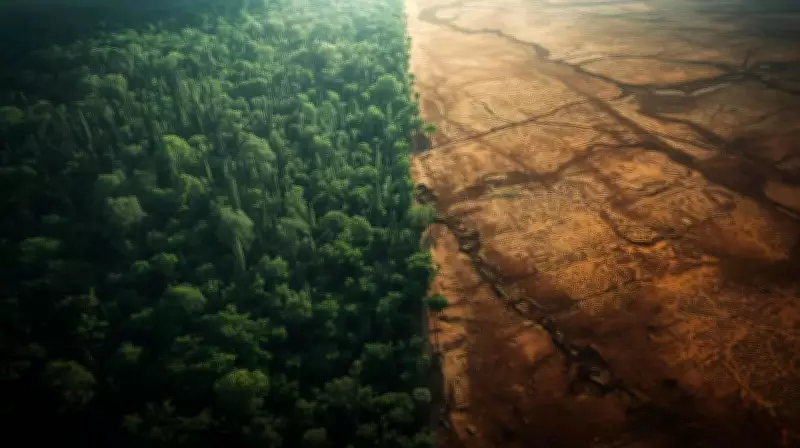
China's Great Green Wall Transforms Taklamakan Desert into Carbon Sink
Across the vast northwestern expanses of China, a desert historically described as barren and lifeless is now exhibiting measurable ecological transformation. New comprehensive research focusing on the Taklamakan Desert has uncovered significant increases in vegetation cover and seasonal carbon absorption, directly linked to decades of state-supported planting initiatives. These findings indicate that sections of this hyperarid region are beginning to function as a modest carbon sink, marking a notable shift in environmental dynamics.
Satellite Evidence Reveals Greening Trends
Scientists meticulously analyzed extensive satellite records alongside ground-based observations, detecting enhanced summer photosynthesis and declining net carbon emissions in areas targeted for restoration. The research firmly connects these positive trends to China's ambitious shelterbelt program, commonly referred to as the Great Green Wall. Although uncertainties persist regarding the full scale and long-term durability of these changes, the data strongly suggests that even extreme drylands can respond positively to sustained ecological engineering efforts. This has potential implications for global carbon management strategies and desertification control measures worldwide.
From Biological Void to Carbon Absorber
For much of modern climate science, the Taklamakan Desert was traditionally treated as a biological void. According to the Royal Geographical Society, rainfall across much of northern China averages between 100 and 250 millimeters annually. The surrounding mountain ranges effectively block moist air, resulting in prolonged dry seasons that have historically limited plant growth.

However, during the wetter months from July to September, precipitation levels edge upward. Researchers recorded average rainfall of approximately 16 millimeters per month during this period. Correspondingly, vegetation cover has shown modest but consistent increases. Satellite indices clearly demonstrate rising photosynthetic activity, while atmospheric carbon dioxide concentrations fall by roughly three parts per million compared to dry season baselines.
The Three-North Shelter Forest Program's Impact
Long-term datasets indicate that vegetation cover has been gradually increasing year after year. Measurements of net ecosystem exchange reveal strengthening carbon uptake, particularly along the desert margins where afforestation efforts have been concentrated. This greening aligns precisely with the timeline of China's Three-North Shelter Forest Program, launched in 1978 and informally known as the Great Green Wall.
The program's primary objectives include slowing the expansion of the Gobi Desert and stabilizing soils near the Taklamakan Desert. Since the project's inception, more than 66 billion trees have been planted across northern China, with official plans outlining billions more plantings by mid-century. These strategically placed forest strips and patches function as effective windbreaks, reducing soil erosion and limiting sand deposition on agricultural lands and human settlements.
Tangible Environmental Benefits
Researchers who compared vegetation indices with data on dust storm severity discovered a strong correlation between increased plant coverage and reduced storm intensity in multiple areas. Since the late 1990s, the number of dust storms in several northern provinces has dropped significantly, though changing weather patterns also contribute to this improvement.
Persistent Desertification Challenges
Despite these positive developments, desertification pressures remain severe across northern China. The backdrop includes longstanding land degradation issues, with rapid urban growth and farmland expansion since the 1950s leaving large tracts vulnerable to wind erosion. Approximately 3,600 square kilometers of grassland are estimated to be lost annually to desert expansion, accompanied by significant topsoil depletion.

The combined area of the Gobi and Taklamakan deserts exceeds 1.6 million square kilometers. Dust originating from these regions has been linked to elevated particulate levels in cities including Beijing, where storms can trap pollution close to ground level. In some areas, such as parts of Gansu province, desert expansion continues despite extensive planting efforts. The southern Taklamakan presents particular challenges due to exceptionally loose geological conditions that hinder vegetation establishment.
Water Stress and Ecological Limitations
Afforestation in arid zones involves significant trade-offs. Trees require substantial water resources, often drawn from already stressed aquifers. In regions like Minqin county, groundwater levels have declined sharply over recent decades. Some plantations have required repeated replanting as saplings struggle to survive under persistently dry conditions.
Ecologists have additionally raised concerns about monoculture planting practices. Poplar and willow trees dominate many shelterbelt areas, and limited species diversity can reduce ecosystem resilience against pests and diseases. In response to these concerns, funding has increasingly been directed toward mixed and indigenous plantings that better support biodiversity.
Long-Term Implications and Uncertainties
The new carbon data, while promising, does not resolve these underlying tensions. However, it provides compelling evidence that human intervention can meaningfully alter surface processes even in the world's driest landscapes. The durability of these ecological shifts will ultimately depend on multiple factors including rainfall patterns, water management strategies, and planting choices in the coming decades.
This transformation of the Taklamakan Desert represents a significant case study in large-scale environmental engineering, demonstrating both the potential and limitations of human efforts to reshape extreme ecosystems for carbon management and desert control purposes.