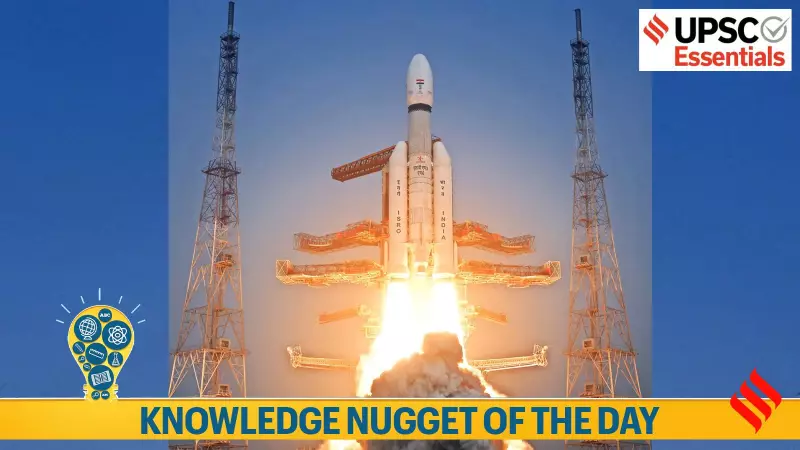
In a landmark achievement for India's space program, the Indian Space Research Organisation (ISRO) successfully launched its heaviest-ever commercial satellite on December 24. The trusted LVM3-M6 rocket, nicknamed 'Bahubali', flawlessly deployed the US-built BlueBird Block-2 communications satellite, weighing nearly 6,100 kg, into its intended orbit.
This mission marks the ninth consecutive success for the LVM3, underscoring its 100% reliability record. More than just a commercial launch, it demonstrates ISRO's growing capability to handle very heavy payloads, a critical requirement for future ambitious projects like the Gaganyaan human spaceflight mission and the construction of the Bharatiya Antariksh Station (Indian Space Station).
Why This Launch Matters for UPSC Aspirants
For candidates preparing for the UPSC Civil Services Examination, understanding ISRO's launch vehicle evolution is a vital part of the Science and Technology syllabus. Questions on launch vehicles like PSLV and GSLV have been asked repeatedly in both Prelims and Mains. The recent LVM3-M6 mission, pushing the boundaries of payload capacity, makes this topic especially relevant for current affairs.

Evolution of India's Space Workhorses: Key Launch Vehicles
India's journey to becoming a leading space-faring nation is built on the backbone of its indigenously developed launch vehicles. Here is a detailed look at the major milestones:
Satellite Launch Vehicle-3 (SLV-3): This was India's first experimental satellite launch vehicle. Its historic success on July 18, 1980, placed the Rohini satellite into a Near-Earth Orbit, proving India's foundational capabilities in rocketry. The SLV-3's design became the architectural basis for future vehicles like the ASLV, PSLV, and GSLV.
Polar Satellite Launch Vehicle (PSLV): Known as the 'workhorse of ISRO', the PSLV is a third-generation launch vehicle. Its development began in 1982, with the first successful launch in October 1994. It can carry payloads up to 1,000 kg to low Earth orbits (below 2,000 km altitude) and boasts an exceptionally high success rate. Landmark missions like Chandrayaan-1 (2008) and the Mars Orbiter Mission, Mangalyaan (2013), were launched aboard PSLV rockets, cementing its legendary status.
Geosynchronous Satellite Launch Vehicle (GSLV): This fourth-generation vehicle was developed to overcome the payload limitations of the PSLV. A key technological leap in the GSLV is its use of cryogenic engines, which use liquid hydrogen and liquid oxygen to provide far greater thrust. This allows it to carry heavier payloads (about 1,750 kg) to higher orbits, including the Geostationary Transfer Orbit (GTO), crucial for communication satellites.
Launch Vehicle Mark-3 (LVM3 / GSLV Mk III): Currently ISRO's most powerful rocket, the LVM3 is a three-stage vehicle using a combination of solid, liquid, and cryogenic engines. Dubbed 'Bahubali' for its strength, it can place up to 8,000 kg into Low Earth Orbit and about 4,000 kg into Geosynchronous Orbit. Its major missions include launching the GSAT-19 satellite in 2017, the 3,850 kg Chandrayaan-2 in 2019, and the successful Chandrayaan-3 in 2023.
Small Satellite Launch Vehicle (SSLV): Designed for the growing market of small satellites, the SSLV is a cost-effective, three-stage vehicle using solid propulsion. It can launch mini, micro, or nano satellites (10-500 kg) to a 500 km planar orbit. It features a Velocity Trimming Module (VTM) for precise satellite placement.
The Future: Next-Generation Heavy Lift Vehicles
ISRO is not resting on its laurels. The agency is already developing its heaviest rocket ever, named the Lunar Module Launch Vehicle (LMLV). Targeted for readiness by 2035, the LMLV is envisioned to be the vehicle for India's future lunar missions, including the planned first human mission to the Moon by 2040.

Beyond the Rocket: The BlueBird Block-2 Satellite
The payload of the historic LVM3-M6 mission, the BlueBird Block-2, is itself a significant piece of technology. Built by the US company AST SpaceMobile, it is part of a low-earth orbit (LEO) constellation designed to provide direct-to-mobile connectivity. Unlike traditional satellites that need ground stations, this constellation aims to communicate directly with standard mobile phones, promising to enable 4G and 5G voice, video, and data services globally.
This successful launch is a testament to ISRO's engineering prowess and strategic vision. For UPSC aspirants, a clear understanding of these launch vehicles—their capabilities, differences, and historical context—is an indispensable part of mastering India's scientific and technological advancements.