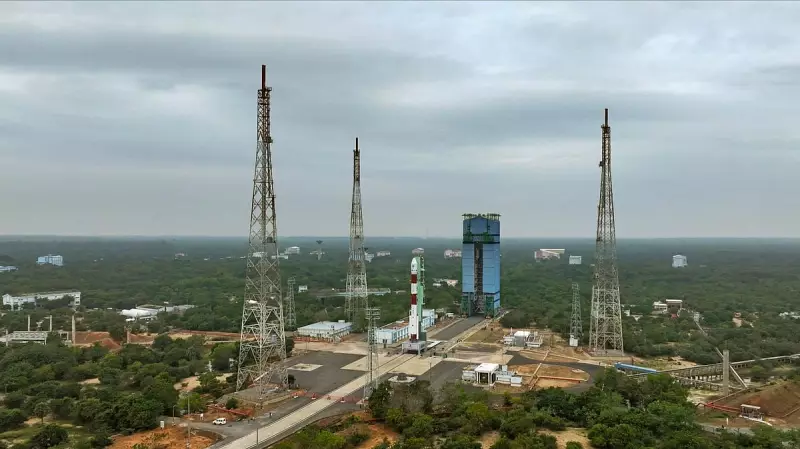
In a significant milestone for India's space program, the Indian Space Research Organisation (ISRO) successfully launched its Polar Satellite Launch Vehicle, PSLV-C62, on Monday morning. The rocket carried the advanced Earth Observation Satellite, EOS-04, along with 14 other co-passenger payloads, marking a powerful start to the year's launch calendar.
A Flawless Lift-Off from Sriharikota
The launch took place at the precise time of 5:59 am on February 14, 2022, from the First Launch Pad at the Satish Dhawan Space Centre in Sriharikota, Andhra Pradesh. The PSLV, in its trusted XL configuration, roared into the pre-dawn sky, performing flawlessly through its various stages. The mission's primary objective was to place the 1,710 kg EOS-04 satellite into its intended sun-synchronous polar orbit.
This mission was particularly notable as it was the first launch of the year 2022 for ISRO. The space agency demonstrated its renowned reliability, with the entire flight sequence, including the separation of the satellites, going exactly as planned. The mission control room at Sriharikota erupted in applause as the final confirmation of successful satellite deployment was received.

The Star Passenger: EOS-04 Satellite
The primary payload, EOS-04, is a sophisticated radar imaging satellite designed for high-quality observations under all weather conditions, day and night. It is a significant addition to India's fleet of remote sensing satellites. EOS-04 is equipped with a powerful C-band Synthetic Aperture Radar (SAR) which can penetrate cloud cover, making it invaluable for applications in agriculture, forestry, soil moisture mapping, and flood mapping.
With a mission life of ten years, EOS-04 will provide crucial data for various sectors. Its capabilities are expected to aid in disaster management, resource monitoring, and strategic applications, bolstering India's self-reliance in space-based earth observation.
Supporting Cast: The 14 Co-Passenger Payloads
Alongside the heavyweight EOS-04, the PSLV-C62 mission also carried 14 smaller satellites, showcasing ISRO's role as a reliable commercial launch service provider. These co-passenger payloads were launched under a commercial agreement with NewSpace India Limited (NSIL), ISRO's commercial arm.
The list of these satellites includes two technology demonstrator satellites named INSPIREsat-1 and INS-2TD. INSPIREsat-1 is a collaborative effort with the Laboratory for Atmospheric and Space Physics at the University of Colorado, USA. INS-2TD is a precursor to the India-Bhutan joint satellite (INS-2B). The remaining payloads were commercial satellites from Indian startups and other customers, highlighting the growing ecosystem of private space enterprises in the country.
Boosting India's Space Ambitions and Economy
The successful PSLV-C62/EOS-04 mission is a multi-faceted achievement. Primarily, it strengthens India's indigenous remote sensing capabilities, providing the nation with critical, high-resolution data for planning and development. The reliable performance of the PSLV-XL variant, once again, cements its reputation as the 'workhorse' of ISRO.
Furthermore, the launch of multiple commercial satellites underscores the increasing commercialization of space activities in India. By reliably delivering customer payloads to orbit, ISRO and NSIL are generating revenue and fostering innovation within the private space sector. This mission serves as a testament to India's growing prowess as a key player in the global space launch market.
The mission also demonstrates ISRO's resilience and focus, coming after a period dominated by the challenges of the COVID-19 pandemic. The flawless execution sets a positive tone for a busy year expected to include other major missions like the Small Satellite Launch Vehicle (SSLV) and the third lunar mission, Chandrayaan-3. The launch from Sriharikota not only delivered advanced technology to space but also delivered a strong message of India's unwavering commitment to space exploration and utilization.