

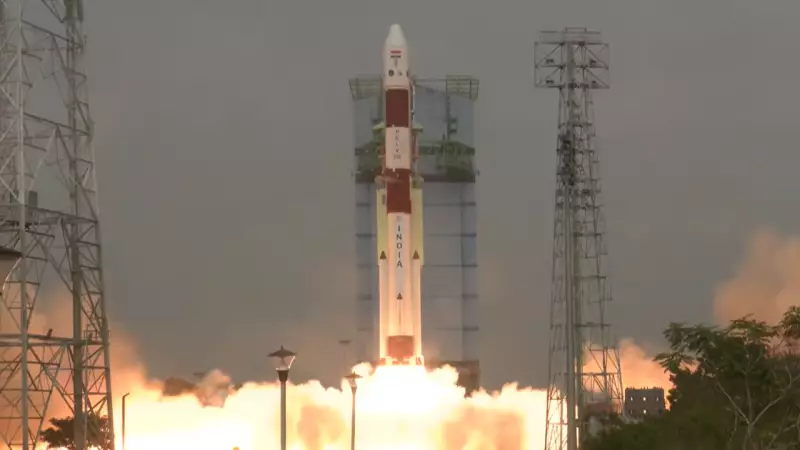
In a powerful return to form, the Indian Space Research Organisation (Isro) on Monday successfully executed a complex 108-minute mission, launching its advanced earth observation satellite EOS-N1 along with 14 co-passenger satellites and a re-entry capsule. The flawless flight of the Polar Satellite Launch Vehicle (PSLV-C62) from Sriharikota marks a significant recovery for the space agency, coming months after a rare launch failure in May 2025.
A Marathon Mission Restores Confidence
The 44.4-metre-tall PSLV-C62 lifted off from the First Launch Pad at the Satish Dhawan Space Centre, Sriharikota, at the start of a commercial mission for NewSpace India Limited (NSIL). This was the 64th flight of the reliable PSLV and the fifth for its DL variant. The mission's success is particularly crucial as it follows the PSLV-C61 failure on May 18, 2025, which resulted from a third-stage anomaly and lost the EOS-09 satellite.
Isro had conducted a thorough review, formed a failure analysis committee, and implemented corrective measures before clearing the launcher for this return-to-flight mission. The agency confirmed that all four stages of the vehicle performed nominally, successfully injecting the primary and secondary payloads into a sun-synchronous orbit at an altitude of about 505 km.

Diverse Payloads Showcase Cutting-Edge Tech
The primary payload, EOS-N1 (Anvesha), is a sophisticated hyperspectral earth observation satellite designed for advanced surveillance and strategic monitoring. The mission, however, was notable for its diverse suite of secondary payloads demonstrating next-generation space technologies.
AayulSAT, developed by Bengaluru-based startup OrbitAID Aerospace, stole the spotlight as India's first on-orbit satellite refuelling demonstrator. This payload aims to test critical technologies for propellant transfer and satellite servicing in low Earth orbit—a capability vital for extending satellite lifespans and promoting sustainable space operations.
Another key technology demonstrator was the Kestrel Initial Demonstrator (KID) re-entry capsule. Developed in collaboration with a Spanish startup, the European capsule separated from the PSLV's fourth stage after it was de-orbited. It was placed on a controlled re-entry trajectory designed to splash down in the South Pacific Ocean, validating technologies for precise atmospheric re-entry.
The co-passenger satellites encompassed a wide range of applications, including:
- AI processing in orbit
- Store-and-forward communication systems
- IoT services and data collection
- Radiation measurement
- Agricultural monitoring
The flight also carried CubeSats and small satellites from Indian entities like Dhruva Space (CGUSAT) and various international partners, supporting global research in communication and Earth observation.
Setting the Pace for 2026 and Beyond
The successful PSLV-C62 mission not only restores momentum for Isro's workhorse launch vehicle but also powerfully kicks off the agency's launch calendar for 2026. It underscores India's growing prowess in providing reliable and cost-effective commercial launch services through NSIL, while simultaneously fostering innovation through partnerships with domestic startups and international collaborators.
By demonstrating critical future technologies like in-orbit refuelling and controlled re-entry in a single mission, Isro has positioned itself at the forefront of the new space economy. The mission reaffirms the robustness of the PSLV platform and sets a confident tone for India's ambitious space agenda in the coming years.






