

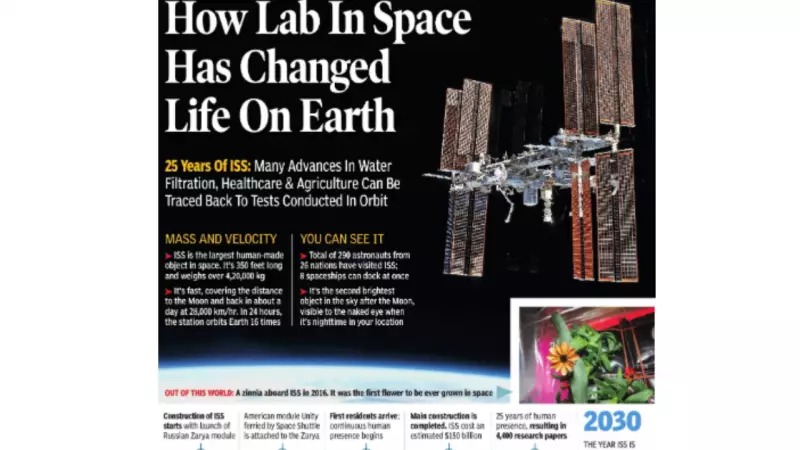
For twenty-five remarkable years, the International Space Station has functioned as an extraordinary laboratory orbiting our planet, providing scientists with unique microgravity conditions impossible to replicate on Earth. This floating research center has fundamentally transformed technologies that now support our hospitals, enhance agricultural productivity, and provide clean water solutions across India and the world.
Healthcare Breakthroughs from Space Research
The weightless environment of space creates changes in human bodies that closely mirror ageing processes on Earth. Scientists observed how microgravity affects bone density and muscle mass in astronauts, leading to groundbreaking discoveries about conditions like osteoporosis and heart strain. These observations resulted in improved exercise protocols for elderly patients and better management of age-related health issues.
One significant innovation tested aboard the ISS was the Myotone Pro device, originally designed to monitor muscle elasticity in astronauts. Researchers quickly realized this noninvasive technology could detect musculoskeletal problems early in patients on Earth, potentially preventing serious conditions from developing.

The space station also served as testing ground for compact ultrasound systems that now operate in ambulances and remote clinics throughout India's rural areas. These portable medical devices bring advanced diagnostics to regions with limited healthcare infrastructure.
Water Purification and Environmental Control
Long before sustainability became a global priority, NASA engineers developed advanced water purification systems for the ISS that could recycle water from virtually any source. The station's Water Recovery System achieved something remarkable: it reduced crew dependence on delivered water by 65%, cutting consumption from nearly three liters daily to just about one liter per astronaut.
This technology proved invaluable for Indian villages lacking stable water infrastructure. The same systems that enable astronauts to recycle 93% of their water now provide safe drinking water in communities across developing nations.
Air quality research conducted on the station led to better humidity-control and air-scrubbing technologies. These innovations now support building ventilation systems, industrial clean rooms, and specialized isolation wards in major Indian hospitals.
Agricultural Innovations and Food Production
In 2015, ISS astronauts celebrated a historic milestone when they sampled the first salad grown entirely in space. The station's space garden has successfully cultivated various plants including three types of lettuce, cabbage, kale, radishes, and peas. Without gravity's influence, plants rely more on chemical signals and light exposure, revealing new understanding about plant stress responses and nutrient utilization.
LED-based plant chambers and sensors tested aboard the ISS helped design energy-efficient lighting systems now common in vertical farms. These advancements allow Indian farmers to reduce power consumption while growing crops in urban environments with limited space.
Research on microbial interactions in space contributed to studies on crop resilience, while combined with satellite data, these findings enhanced precision agriculture models that help Indian farmers better manage water resources and soil health.
Disaster Management and Emergency Response
The ISS orbits over approximately 90% of Earth's population, giving astronauts a comprehensive view of natural disasters as they unfold. Over the years, crew members have photographed storms, wildfires, volcanic eruptions, and earthquake aftermaths, supplementing satellite imagery and guiding first responders during emergencies.
A powerful example of space station knowledge aiding Earthbound emergencies occurred in 2010 when thirty-three Chilean miners were trapped underground for over two months. NASA experts, accustomed to managing astronaut health in confined spaces, recommended providing the miners with Vitamin D supplements—the same nutrient space crews need when deprived of direct sunlight. They also advised on group dynamics management, crucial for preventing conflicts in tight quarters.

Since the year 2000, more than 4,000 experiments have been conducted aboard the International Space Station. Many of these investigations have yielded practical applications that directly benefit Indian communities, from advanced medical devices to sustainable farming techniques and clean water solutions. As the ISS celebrates twenty-five years of operation, its legacy continues to grow, proving that research conducted 400 kilometers above Earth can dramatically improve life on our planet.





