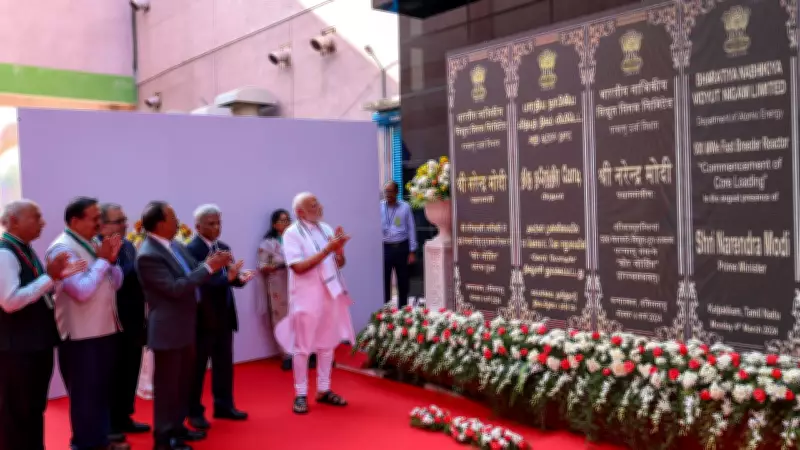
India's Prototype Fast Breeder Reactor at Kalpakkam Achieves Criticality
In a significant advancement for India's civil nuclear energy sector, the indigenously designed and constructed Prototype Fast Breeder Reactor (PFBR) located at Kalpakkam in Tamil Nadu has successfully attained criticality. This milestone represents a major boost to the country's nuclear power production capabilities and underscores its growing technological prowess.
Prime Minister Modi Hails the Achievement
Prime Minister Narendra Modi took to social media to congratulate the scientists and engineers involved in this groundbreaking project. In his post, he stated, "Today, India takes a defining step in its civil nuclear journey, advancing the second stage of its nuclear programme." He further emphasized that this advanced reactor, which can produce more fuel than it consumes, showcases the depth of India's scientific capability and the strength of its engineering enterprise.
The Prime Minister highlighted that this development is a decisive step towards harnessing India's vast thorium reserves in the third stage of the nuclear programme, calling it "a proud moment for India."

Understanding Criticality and Its Significance
Criticality in a nuclear reactor refers to the point at which it achieves a self-sustaining chain reaction. This is a crucial milestone that precedes full power generation and indicates that the reactor core is functioning as designed. Achieving criticality validates the engineering and safety protocols, paving the way for operational readiness.
Technical Specifications of the PFBR
The PFBR is a pool-type, sodium-cooled fast breeder reactor with a capacity of 500 MWe (1,253 MW thermal). It utilizes mixed oxide (MOX) fuel, which is composed of uranium-238 and plutonium-239. This design is integral to India's strategy of reducing dependence on imported uranium and establishing a closed nuclear fuel cycle.
Unlike the existing Pressurized Heavy Water Reactors (PHWRs) that rely on uranium, the PFBR employs fast neutrons and liquid sodium coolant. This enables it to produce more plutonium than it consumes, directly facilitating the second stage of India's three-stage nuclear power programme. The reactor serves as a vital bridge towards the eventual utilization of India's extensive thorium reserves.
Indigenous Development and Global Standing
The PFBR has been entirely designed and built by Bharatiya Nabhikiya Vidyut Nigam Limited (BHAVINI), a public sector enterprise. The project saw significant contributions from over 200 Indian industries, including numerous MSMEs, highlighting a collaborative national effort.
Once commissioned, India will join an elite group, becoming only the second country after Russia to operate a commercial Fast Breeder Reactor. This achievement not only enhances India's energy security but also positions it as a leader in advanced nuclear technology on the global stage.
Implications for India's Nuclear Future
The successful criticality of the PFBR marks a transformative phase in India's nuclear energy landscape. It accelerates progress towards:
- Reducing reliance on fossil fuels and imported uranium.
- Advancing the three-stage nuclear programme to leverage thorium reserves.
- Strengthening India's position in sustainable and clean energy production.
This milestone reflects years of dedicated research, innovation, and engineering excellence, setting a precedent for future advancements in the nuclear sector.