

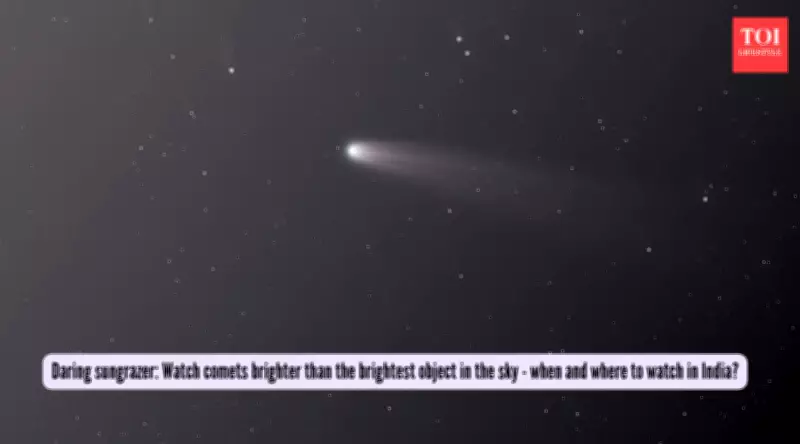
MAPS Comet: A Daring Sungrazer Set to Outshine Venus in 2026
Comets rank among the most luminous, captivating, and enigmatic entities in the cosmos, yet the notion of one surpassing the brilliance of the 'brightest object in the night sky' might appear mythical. However, a newly discovered celestial wanderer is poised to challenge this perception, promising an extraordinary spectacle for skywatchers globally.
Discovery and Origins of Comet C/2026 A1 (MAPS)
A groundbreaking discovery occurred on January 13, 2026, when French amateur astronomers Alain Maury, Georges Attard, Daniel Parrott, and Florian Signoret identified a novel comet using their telescopes based in Chile. Designated as C/2026 A1, it earned the nickname MAPS from the initials of its discoverers. Remarkably, this comet holds the record for being the farthest-out sungrazer ever detected at its initial observation, suggesting it may possess an immense size that could lead to unprecedented brightness.
According to reports from Starwalk News, the MAPS comet belongs to the Kreutz sungrazing family, a group named after German astronomer Heinrich Kreutz. Unlike conventional comets that maintain a safe orbital distance from the Sun, Kreutz sungrazers undertake perilous journeys, diving exceptionally close to our star. This proximity subjects them to intense solar heat, which sublimates their icy compositions into gas, generating radiant glows that can occasionally be visible even in broad daylight. However, this daring approach carries a significant risk: the extreme conditions near the Sun can completely disintegrate these comets.

What Are Daring Sungrazers?
Kreutz sungrazers trace their lineage back to a colossal parent body, estimated to have been over 100 kilometers in width, which grazed the Sun around the 3rd or 4th century BCE. This massive object fractured into two substantial pieces and countless smaller fragments, which have reappeared over the centuries as record-breaking comets. For instance, the Great Comet of 1882 achieved a peak brightness approximately 100 times greater than that of a full Moon, dominating night skies for several months and leaving a lasting impression on observers.
When and Where to Witness the Bright Comet
The MAPS comet is scheduled to reach its perihelion, or closest approach to the Sun, on April 4–5, 2026. During this event, it will skim merely about 170,000 kilometers above the solar surface. If it survives this treacherous passage, astronomers anticipate that it could shine with a luminosity comparable to Venus, potentially making it visible to the naked eye during daytime hours. Observers might also witness a striking turquoise tail, formed by exotic gases released during its solar encounter.
How and When to Observe It from India
For enthusiasts in India, particularly those in southern regions, the best opportunity to catch a glimpse of the MAPS comet will occur in early April, approximately 30–45 minutes after sunset. It will appear low in the southwestern sky, and using binoculars or small telescopes is recommended to enhance visibility against the solar glare. In contrast, observers in northern areas may face greater challenges due to horizon clutter and atmospheric interference, which could obscure the view.
To aid in tracking this celestial event, skywatchers can utilize astronomy applications such as Stellarium, which provide real-time updates and positioning data for comets and other astronomical phenomena. This tool can be invaluable for planning observation sessions and maximizing the chances of witnessing this rare and dazzling display.






