

Mars Rotation Accelerates, Challenging Views of a Dormant Planet
For decades, Mars has been perceived as a quiet, geologically inactive world—cold, dusty, and largely unchanging. However, groundbreaking scientific findings are now reshaping this image in unexpected ways. Recent research has revealed that Mars is not as static as once believed; in fact, its rotation is speeding up each year, subtly shortening the Martian day.
Precision Measurements Uncover Subtle Changes
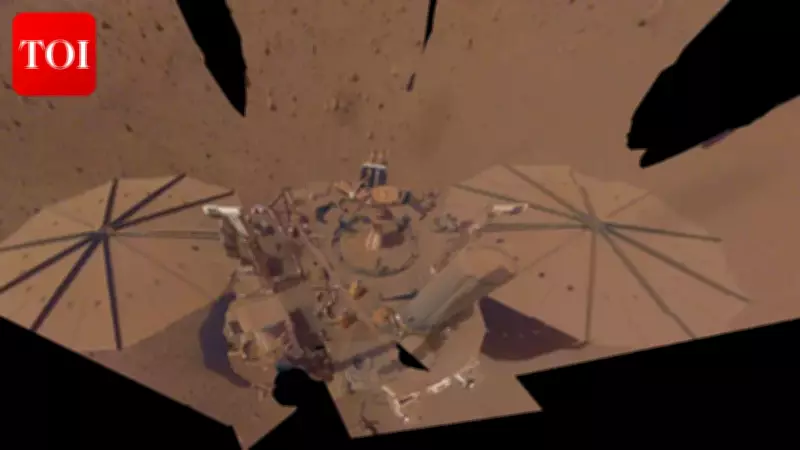
The discovery stems from data collected by NASA's InSight lander, which employed a sophisticated instrument called the Rotation and Interior Structure Experiment (RISE). Through a study titled 'Spin state and deep interior structure of Mars from InSight radio tracking,' scientists determined that Mars' spin is increasing by 4 milliarcseconds annually. This translates to a reduction in the length of a Martian day by a fraction of a millisecond each year.
Sebastien Le Maistre, the lead scientist on the project, emphasized the significance of this finding: "It takes a very long time and a lot of data to see these small changes." The level of accuracy required for this detection highlights advancements in space observation technology, marking a notable achievement in planetary science.

Unraveling the Causes Behind the Speedup
Initially, researchers theorized that shifts in mass distribution on Mars might be responsible for the acceleration. Potential factors included ice buildup on polar caps or ground settling from previous ice formations, akin to an ice skater spinning faster by pulling their arms inward. However, more recent studies, such as those from Advancing Earth and Space Sciences in 2026, suggest a more complex mechanism.
Evidence points to a massive plume of lighter elements rising within Mars' mantle, creating a negative mass anomaly that accelerates the planet's rotation. This phenomenon is similar to pulling an object inward during a spin, indicating dynamic internal processes previously unrecognized.
Implications for Mars' Interior and Evolution
The implications of this discovery extend far beyond mere rotation changes. If a mantle plume is indeed driving the speedup, it suggests that Mars may harbor active geological processes beneath its surface. This activity could extend to volcanic regions like Tharsis, home to some of the solar system's largest volcanoes.
Bruce Banerdt, principal investigator of the InSight mission, expressed enthusiasm: "It’s really cool to be able to get this latest measurement." This finding challenges the notion of Mars as a dead planet, hinting at lingering heat and ongoing evolution that could reshape our understanding of its history.
Practical Importance for Future Missions
Understanding Mars' rotation is not merely academic; it has critical practical applications for space exploration. Precise knowledge of the planet's spin is vital for navigation, landing missions, and timing systems, especially as missions become more sophisticated. Even small changes in rotation can impact calculations for spacecraft, making this data essential for future human expeditions to Mars.
A Dynamic World Revealed
Mars continues to surprise scientists, unveiling hidden complexities beneath its seemingly tranquil exterior. The accelerating rotation serves as a subtle clue to larger internal motions and geological activity, suggesting that the planet may be more dynamic than ever imagined. This discovery reminds us that even the quietest worlds can harbor powerful secrets, waiting to be uncovered through persistent exploration and innovation.






