

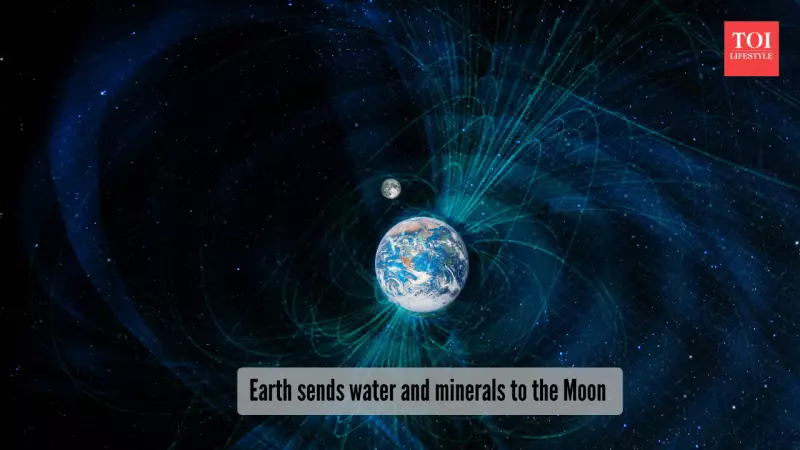
For centuries, the Moon has been Earth's constant celestial companion, illuminating our nights and governing our tides. But a groundbreaking new study suggests its role is far more profound: the Moon is a silent collector, meticulously gathering tiny particles from Earth's own atmosphere over billions of years.
Lunar Soil Holds Earth's Ancient Secrets
This revelation isn't pure speculation. It is grounded in hard evidence from Apollo mission samples collected in the 1970s. Scientists found that lunar soil contained surprising amounts of volatile elements like water, nitrogen, and argon. The quantities were higher than what could be explained by solar wind alone, pointing to an additional, mysterious source.
New research from the University of Rochester now provides a compelling answer. The study posits that Earth itself is actively contributing material to the lunar surface, a process that continues even today. "By combining data from particles preserved in lunar soil with computational modeling, we can trace the history of Earth's atmosphere and its magnetic field," explains co-author Eric Blackman. This effectively transforms Moon dirt into a unique historical archive of our home planet.

Magnetic Highways Guide Earth's Particles
How do particles from our dense atmosphere make the 384,400-kilometre journey to the Moon? The process is a delicate cosmic dance. Simulations compared early Earth—which lacked a strong magnetic field and faced intense solar wind—with our modern planet.
Surprisingly, the current setup is remarkably efficient at delivery. Solar ions strike the fringes of our atmosphere, knocking loose neutral and charged particles. Earth's magnetic field lines then act like invisible rails, guiding these particles tens of thousands of kilometres toward the Moon's orbit. It's not a torrential downpour but a slow, steady drizzle of mineral-rich "rain" over eons.
This finding challenges old assumptions that Earth's magnetic field completely blocks atmospheric escape. Instead, it creates selective "highways" for particles to slip through.
A Pristine Archive and a Future Resource
The Moon, with its lack of weather and tectonic activity, is the perfect vault. Particles that land on its surface stay put, creating layered records. These layers could tell the story of Earth's shifting atmosphere, continental movement, volcanic eruptions, the evolution of life, and even human impact.
This discovery has two monumental implications:
- Scientific Treasure: The Moon becomes a priceless repository for studying Earth's deep past, offering clues unavailable on our geologically active planet.
- Resource Potential: It boosts the viability of future lunar outposts. The so-called "dry" Moon may harbor resources—water and minerals—delivered as gifts from Earth, which could be crucial for long-term scientific survival and exploration.
The next steps involve digging deeper, both literally and figuratively. Future missions will aim to sample different depths and locations on the Moon, checking chemical fingerprints to definitively separate Earth-derived material from solar or cometary bits. Our closest celestial neighbour, it seems, has been quietly holding a mirror to Earth, capturing our atmospheric story speck by invisible speck.






