

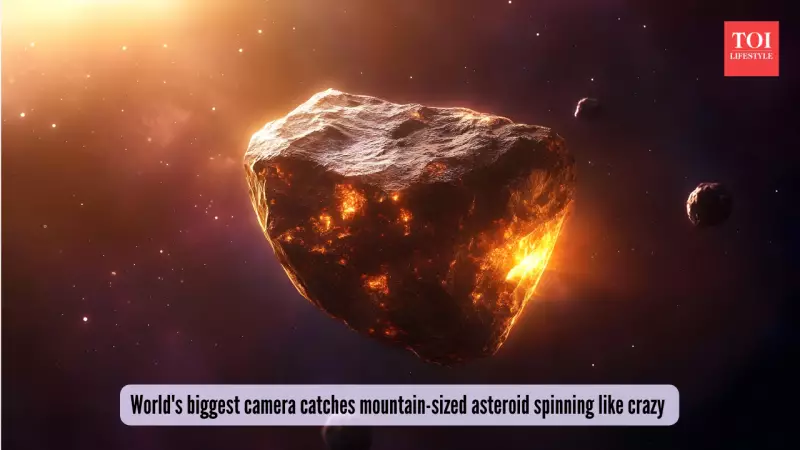
Asteroids represent some of the most captivating celestial objects in the cosmos, serving as ancient space debris left over from the formation of our Solar System. These primordial remnants offer invaluable clues about the universe's early history. Recently, a groundbreaking discovery has captured global attention: a mountain-sized asteroid detected by the world's most powerful digital camera, revealing unprecedented details about these mysterious space rocks.
Revolutionary Observatory Unveils Cosmic Secrets
Perched high in the mountains of Chile, the Vera C. Rubin Observatory represents a technological marvel that is fundamentally changing our understanding of the cosmos. This state-of-the-art facility houses the Legacy Survey of Space and Time (LSST) Camera, which at 3,200 megapixels stands as the largest digital camera ever constructed on Earth. During its inaugural imaging sessions in June 2025, this astronomical powerhouse identified thousands of previously hidden asteroids, with nearly 2,000 being completely new discoveries to science.
Record-Breaking Discovery Among the Stars
In what astronomers are calling a 'first look' event, the observatory flagged 19 ultra-fast spinning asteroids hurtling through our Solar System. The most remarkable among these is main-belt asteroid 2025 MN45, measuring an impressive 710 meters in width. Data collected over seven nights in April and May 2025 revealed this celestial body completes a full rotation every 1.88 minutes, making it the fastest-spinning large asteroid (with a diameter exceeding 500 meters) ever documented.

Why Asteroid Spin Speed Matters for Science
Asteroids serve as cosmic time capsules, preserving material from the Solar System's formation approximately 4.5 billion years ago. Their rotation rates provide crucial insights into their composition, internal structure, and collision history. Typically, main-belt asteroids rarely spin faster than once every 2.2 hours without disintegrating from centrifugal forces—unless they possess extraordinary structural integrity.
Surprising Strength Defies Expectations
"Clearly, this asteroid must be made of material that has very high strength in order to keep it in one piece as it spins so rapidly," explains lead researcher Sarah Greenstreet of the Rubin Observatory's Solar System Science Collaboration. "We calculate that it would need a cohesive strength similar to that of solid rock. This is somewhat surprising since most asteroids are believed to be what we call 'rubble pile' asteroids—loose collections of rocks held together by gravity rather than solid structures."
New Era of Asteroid Discovery Dawns
The Vera Rubin Observatory excels at detecting distant, fast-spinning asteroids in the main belt that were previously challenging to observe. Remarkably, 18 of the 19 newly discovered rapid rotators are located in this region or beyond, promising a wealth of fresh scientific data. "As this study demonstrates, even in early commissioning, Rubin is successfully allowing us to study a population of relatively small, very-rapidly-rotating main-belt asteroids that hadn't been reachable before," Greenstreet adds, highlighting the observatory's transformative potential.
The LSST Camera's decade-long survey of the southern sky aims to catalog detailed information about 76 asteroids' rotation periods, with 16 completing spins in under 2.2 hours. This discovery marks the beginning of what astronomers anticipate will be a golden age of sky-scanning, where advanced technology reveals cosmic secrets that have remained hidden for billions of years.






