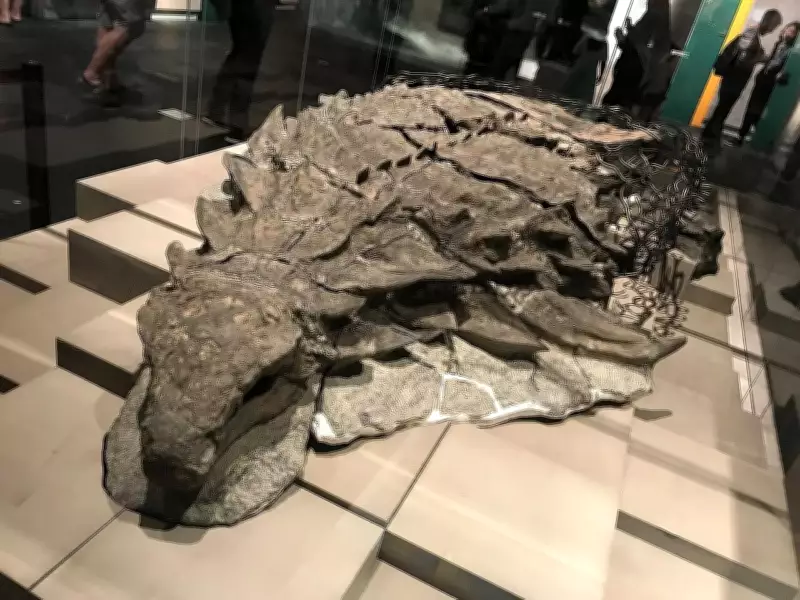
A volunteer scout recently made a spectacular discovery in Dinosaur Provincial Park, a region known as the Alberta Badlands. While exploring a steep incline, the scout uncovered not just a piece of fossilized bone but a large leg and tail protruding from the hill, complete with scaly skin. This rare find is believed to belong to a juvenile hadrosaur, a duck-billed herbivore that roamed the area approximately 75 million years ago.
Significance of the Find
In paleontology, discovering mummified skin is considered the ultimate jackpot. Soft tissues typically decay rapidly after death, long before the skeleton can fossilize. Finding preserved skin texture after millions of years is akin to finding a photograph in a world where only footprints remain. The University of Reading, in collaboration with the Royal Tyrrell Museum of Palaeontology, has initiated a large-scale rescue mission. Optimism surrounds the site, as further excavation may reveal a complete and well-preserved skeleton.
Preservation in the Alberta Badlands
Scientists have long puzzled over why the Canadian badlands yield so many mummified fossils. A study published in PLOS One reveals that burial processes during the Late Cretaceous era played a key role. Contrary to the assumption that instant burial by a landslide is necessary, research suggests that carcasses could desiccate naturally, hardening the skin enough to survive until sediment eventually covers them.

This particular juvenile hadrosaur offers a unique opportunity to study the middle growth stages of dinosaurs, as fossils of young individuals are rare. Each piece of skin extracted provides valuable information about the creature's development.
Excavation Challenges
Extracting the skeleton from the steep slope is a slow, meticulous process. Excavators must stand on tiny ledges and hand-chip rock around the remains. The University of Reading experts estimate the work may take several summer expeditions. Fossilized skin is extremely fragile and can crumble if exposed to air too quickly or handled roughly. Research in PeerJ highlights the importance of careful handling to preserve individual scale patterns and microscopic skin layers.
Once freed, the bones will be transported to a specialized lab for thousands of hours of preparation. If the skin extends across the hadrosaur's body as expected, this could become one of North America's most significant fossil finds. For the volunteer who discovered the tail protruding from the dirt, this marks a second remarkable find in their lifetime.