NASA's Artemis II Mission Revolutionizes Space Communication with Live Streaming
During the uncrewed Artemis I test flight, NASA flight director Zebulon Scoville identified a critical gap in the agency's public engagement strategy. He realized NASA was not consistently livestreaming the spacecraft's journey, citing bandwidth limitations as the primary constraint. Scoville challenged this approach, emphasizing that public support is essential for the program's success.
Transforming Communication for Public Engagement
Scoville dedicated two years to developing a solution to bring the public along on NASA's new Moon missions. His efforts led to the integration of an optical communications system onto the Orion spacecraft. This innovative laser technology transmitted data to a ground station on Earth, enabling the delivery of high-resolution streaming video.
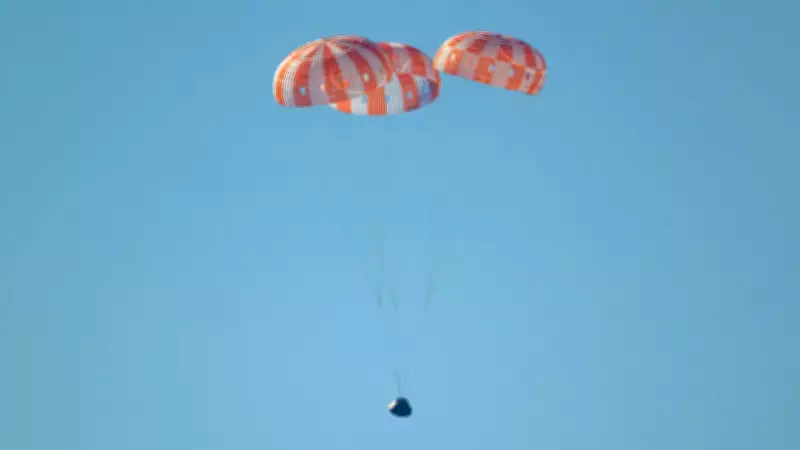
The impact of this initiative was fully realized during the Artemis II crewed test flight, which concluded on Friday with an emotional splashdown off the California coast. Throughout the more than nine-day mission, NASA maintained continuous live programming on its dedicated streaming platform and across various social media channels.

Widespread Public Engagement and Educational Impact
The enhanced streaming strategy, combined with coverage from third-party streamers and broadcast news outlets, garnered millions of views globally. Institutions such as museums organized Artemis splashdown parties, fostering community involvement. Alex Roethler, a physics teacher from Wisconsin, highlighted the educational value, noting the availability of livestreams for students and the innovative use of platforms like Twitch, popular among gamers.
Crew Involvement and Emotional Storytelling
The Artemis II crew played a pivotal role in the mission's narrative. During the nearly seven-hour lunar flyby, astronauts Christina Koch, Victor Glover, Jeremy Hansen, and Reid Weisman provided vivid, near-literary descriptions of lunar surface features, captivating audiences and leaving mission control in Houston awe-struck.
Scoville reflected on the shift in NASA's communication style, stating that Artemis II has been marked by genuine smiles and emotional expression, contrasting with the agency's historically more reserved demeanor. He emphasized the importance of enthusiasm, remarking that it is acceptable to celebrate achievements with excitement and passion.
This transformation in space communication not only enhances public engagement but also sets a new standard for future missions, demonstrating the power of technology and storytelling in inspiring global audiences.