

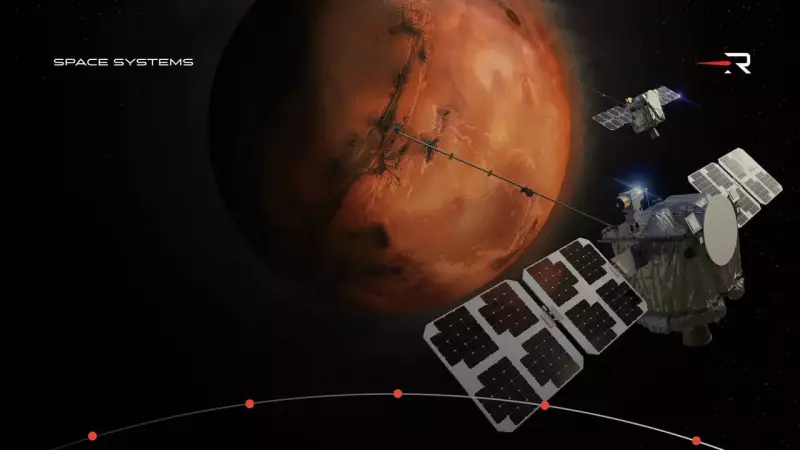
In an exciting development for space exploration, NASA is preparing to launch its revolutionary ESCAPADE mission this weekend. The ambitious project aims to solve one of Mars' greatest puzzles: how the Red Planet lost its thick atmosphere that once supported flowing water billions of years ago.
Mission Launch Details and Innovative Approach
On November 9, NASA will deploy two identical twin satellites named Blue and Gold aboard Blue Origin's powerful New Glenn rocket from Cape Canaveral, Florida. What makes this mission particularly remarkable is its modest budget of $80 million, significantly lower than traditional space missions, marking NASA's first-ever venture sending two spacecraft to orbit another planet together.
The ESCAPADE probes, developed and operated by the University of California, Berkeley, will create an unprecedented 3D stereo view of Mars' magnetosphere and upper atmosphere. Scientists hope to unlock the secrets of how solar wind - the constant stream of charged particles from the Sun - stripped away Mars' protective atmosphere over billions of years after the disappearance of its global magnetic field.

Revolutionary Mars Trajectory and Scientific Goals
This mission breaks from tradition in how spacecraft reach Mars. Instead of using the conventional Hohmann transfer orbit that depends on planetary alignment every 26 months, ESCAPADE will follow an innovative trajectory. The satellites will first travel to a Lagrange point - a gravitational sweet spot between Earth and Sun - where they will orbit for approximately one year before slingshotting back around Earth and heading to Mars.
This approach allows for greater flexibility in launch schedules, representing a crucial advancement for future crewed missions that may require launching multiple spacecraft over extended periods rather than narrow windows. The satellites are expected to arrive at Mars in 2027, where they will spend months adjusting their orbits before flying in close formation.
Implications for Future Human Exploration
Once operational, Blue and Gold will capture minute-to-minute changes in Mars' patchy magnetic bubbles and thin ionosphere. These observations will help scientists forecast solar storms and radiation risks - essential information for future astronauts who may live and work on the Martian surface where radiation levels far exceed those on Earth.
Understanding these atmospheric processes will not only reveal Mars' climate history but also provide critical insights into protecting Earth's atmosphere from similar solar threats. The mission stands at the intersection of scientific discovery, technological innovation, and humanity's quest to become an interplanetary species.
By creating a detailed map of Mars' magnetic environment and atmosphere, ESCAPADE lays the groundwork for understanding the Red Planet's dramatic transformation from a once-habitable world to a frozen desert. The mission represents more than just scientific curiosity - it's a vital piece in the puzzle of our cosmic future, demonstrating that with innovation and collaboration, new frontiers in space exploration can be successfully reached.






