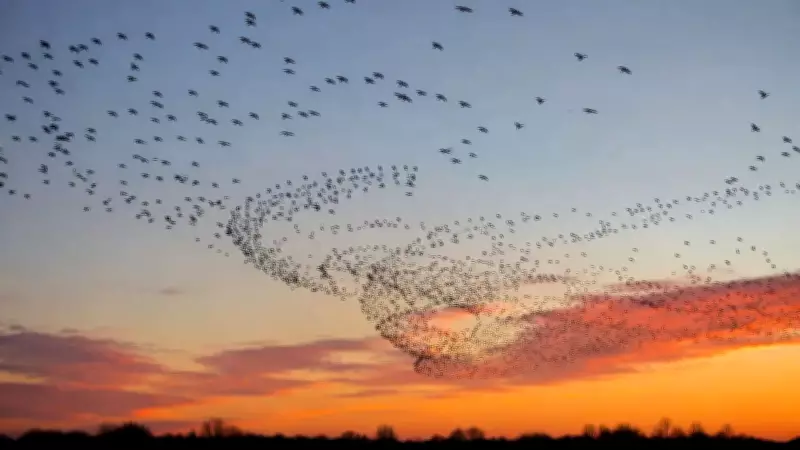
When a flock of birds wheels across the sky, the movement appears effortless. Hundreds of individuals change direction within moments, yet the group remains coherent. For decades, physicists have used such collective behaviour to explore how complex systems organise themselves. What they often encountered, however, was an awkward problem. Many living systems do not interact in the neat, balanced way described by classical physics. A bird may react to a neighbour ahead while ignoring one behind. Cells moving through tissue can respond selectively to their surroundings. These seemingly ordinary behaviours create difficulties for mathematical models that rely on one of physics' oldest assumptions: that forces act equally in both directions.
Why bird flocks appear to break Newton's laws
Much of classical mechanics rests on the idea that interactions are reciprocal. Push against a wall, and the wall pushes back. The same principle underpins countless equations used to describe motion, energy and change. According to the study titled “Hamiltonian description of non-reciprocal interactions”, many collective systems do not follow that pattern. A bird in flight typically pays attention to what lies ahead or alongside it rather than behind it. Similar one-way interactions appear in bacterial swarms, moving cells and even dense human crowds. In these situations, influence travels unevenly through the system.
The challenge has been practical as much as theoretical. Existing methods often depend on assigning a clear interaction energy between components. Once interactions become one-sided, that description begins to break down. Simulations remain possible, but they become harder to analyse and often require more computational effort.

The new theory that helps explain bird flocks and one-way interactions
The new work tackles the problem through an unusual approach. Rather than changing the behaviour of the system itself, the researchers introduced additional mathematical counterparts for every interacting component. According to the study published in NaturePhysics, these auxiliary variables act as partners that exist only within the model. Together with the real components, they create a larger framework in which interactions become reciprocal once again.
"The trick behind the new theory is that it constructs a partner for each component of the system, a fictitious partner that doesn't exist in nature," the authors write in the study. Using this arrangement, the original behaviour remains unchanged, but the mathematics becomes compatible with techniques normally reserved for systems that obey reciprocal interactions. In effect, the researchers found a way to translate a difficult problem into a language that existing physics tools can understand.
How the new physics framework could improve bird flock simulations
One consequence of the framework is that it allows non-reciprocal systems to be studied using approaches that previously could not be applied directly. The authors demonstrated that simulations based on the new formulation reproduce the same behaviour as conventional descriptions of these systems. This opens the possibility of examining large collections of interacting agents more efficiently. Models of flocking animals, active matter and biological tissues could potentially be explored with a level of precision that has been difficult to achieve.
As per the study published in NaturePhysics, the method can work with systems that change over time rather than settling into a stable state. In some examples, patterns continued to move and evolve indefinitely, yet the new framework remained able to capture their behaviour.
Why physicists see potential beyond Newton's laws
While birds provide an intuitive example, the implications extend far beyond animal movement. Non-reciprocal interactions have been observed in a wide range of physical and biological systems, from microscopic particles suspended in fluids to robotic materials designed to respond unevenly to external forces. The researchers suggest that their framework could eventually help expand statistical mechanics into areas where traditional assumptions no longer hold. It may also offer new ways to investigate driven systems whose behaviour can be altered through carefully controlled external influences.

According to the study published in NaturePhysics, it stops short of claiming that it reveals new physics by itself. Instead, it provides a mathematical bridge. By restoring access to familiar analytical tools, the framework allows scientists to ask questions about non-reciprocal systems that were previously difficult to approach. For physicists interested in collective behaviour, that may prove valuable. The motions of bird flocks, bacterial colonies and living tissues have long hinted that nature often operates outside the neat symmetry taught in introductory mechanics. The latest work suggests those systems may now be easier to explore without rewriting the foundations of physics from scratch.