

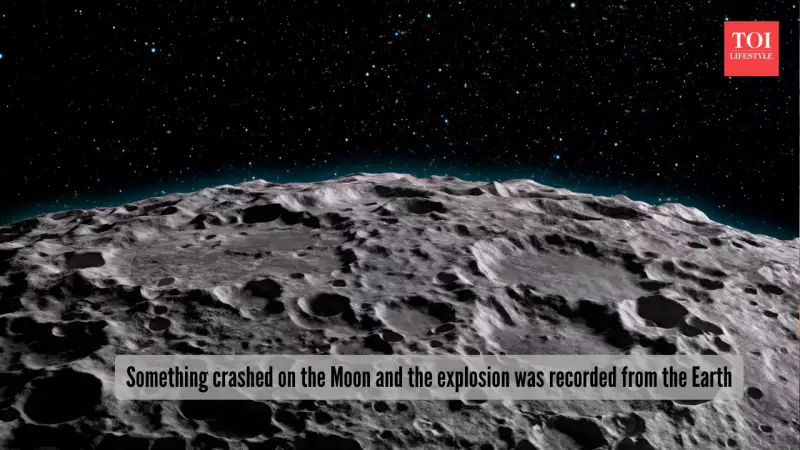
The Moon, our planet's constant and serene celestial companion, is more than just a beautiful sight. Its scarred surface tells a violent history of cosmic collisions. In a remarkable observation, astronomers have recently witnessed this protective role in real time, capturing a fleeting explosion caused by a space rock hitting the lunar surface.
A Flash in the Lunar Night
On December 12, 2025, at 03:09:36 UTC, a brilliant white flash momentarily lit up the dark side of the Moon. The event was recorded by astronomers at the Armagh Observatory and Planetarium (AOP) in Ireland. This recording is significant as it marks the first video of a lunar impact flash captured from Ireland and only the second such recording from the UK.
The observation was made by PhD student Andrew Marshall-Lee using the Armagh Robotic Telescope (ART). The brief burst of light was consistent with a small meteoroid striking the Moon at high speed. The timing of the impact is particularly noteworthy, as it occurred just before the peak of the annual Geminid meteor shower on December 13.

The Geminid Connection and Lunar Protection
Researchers at AOP pointed to the Geminids as the prime suspect for this event. This meteor shower originates from the asteroid 3200 Phaethon. "Lunar impact flashes are rare events and are seen only very occasionally, although they are more likely to be detected during major meteor showers," stated the observatory.
This incident underscores a critical cosmic function of the Moon: it acts as Earth's shield. The countless craters on its airless surface are proof that it absorbs countless hits from space debris that would otherwise threaten our planet. The objects causing these flashes are often tiny, smaller than a golf ball, and too faint to see in space. However, when they collide with the Moon at tremendous velocities, their kinetic energy is instantly converted into intense heat and light, creating a flash that lasts a fraction of a second.
The Challenge of Capturing Cosmic Collisions
Spotting these transient events requires a combination of specialized equipment, patience, and a bit of luck. Astronomers need telescopes with apertures larger than 20 centimeters, equipped with fast cameras, and they must patiently monitor the Moon's dark side. This recent Irish observation follows two other lunar impacts recorded in November by an amateur astronomer, who shared the findings on his social media account.
While teams continue to analyze the data to confirm the exact source of the December impact, the link to the Geminid meteor stream appears strong. These observations are vital as they help scientists understand the flux of meteoroids bombarding the Moon and, by extension, the near-Earth environment. Each captured flash is a stark reminder of the dynamic and sometimes hazardous nature of our solar system.






