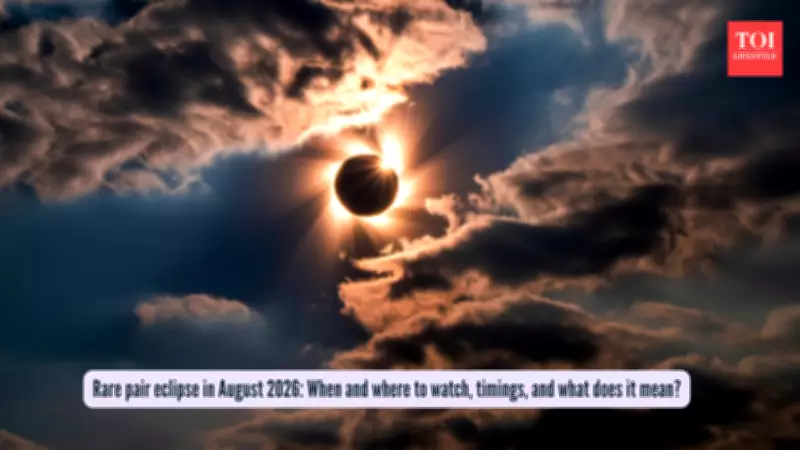
The cosmos continues to captivate humanity with its profound wonders and ancient mysteries, reminding us of our humble place in the vast universe. Solar and lunar eclipses, in particular, evoke a sense of magic, as if the Moon and Sun are staging a celestial performance just for Earth's inhabitants. The year 2026 is shaping up to be a remarkable period for such events, with four eclipses scheduled, two of which have already occurred in March. Now, attention turns to a rare twin eclipse phenomenon set for August 2026.
Rare Eclipse Pair to Take Place in August 2026
August 2026 marks the second and final eclipse season of the year, promising an exciting astronomical display. This season will feature two distinct eclipses occurring within a short timeframe, offering skywatchers a unique opportunity to witness celestial alignments.
1: Total Solar Eclipse on August 12
The eclipse season reaches its peak on Wednesday, August 12, 2026, with a total solar eclipse. During this event, the Moon will completely obscure the Sun for several minutes along a narrow path that traverses Greenland, Iceland, and northern Spain. Observers within the path of totality will experience a dramatic transformation: daytime will plunge into darkness, temperatures may drop slightly, and the Sun's glowing corona will become visible, creating a breathtaking sight. A strong partial eclipse will be observable across much of Europe, North Africa, and the North Atlantic, allowing a broader audience to partake in this celestial spectacle.

2: Partial Lunar Eclipse on August 28
Just over two weeks later, on Wednesday, August 28, 2026, a partial lunar eclipse will occur. Earth's shadow will darken a significant portion of the Moon's face, though not as dramatically as during a red "blood moon" total lunar eclipse. This event will still offer a beautiful view, with the Moon entering Earth's umbra. Skywatchers in North America, South America, Europe, and Africa will have the chance to observe this partial eclipse as it unfolds in the night sky.
Will These Eclipses Be Visible in India?
Unfortunately, neither the August 12 total solar eclipse nor the August 28 partial lunar eclipse will be visible from India. The path of the total solar eclipse crosses regions thousands of miles away, including Greenland, Iceland, and northern Spain, meaning Indian observers will experience a normal sunny day on August 12. Similarly, for the partial lunar eclipse, the Moon will be below India's horizon during the prime viewing hours. By the time the Moon rises around 7 PM IST, Earth's shadow will have already passed, leaving only a normal full Moon visible to viewers in India.
Understanding Eclipse Seasons: Why Two Eclipses Happen Consecutively
Eclipses often seem like distant, sporadic events, but they actually follow a predictable pattern, nearly always occurring in pairs during brief periods known as eclipse seasons. These seasons happen about twice each year, with windows lasting 31 to 37 days and recurring roughly every 173 days. Every eclipse, whether solar or lunar, takes place within one of these seasons, and no eclipses can occur outside them.
What Causes Eclipse Seasons?
Eclipses only happen during specific alignments called syzygy. For solar eclipses, this occurs at a new moon when the Moon is directly between Earth and the Sun. For lunar eclipses, it happens at a full moon when Earth is positioned between the Moon and the Sun. Eclipse seasons arise when these alignments occur near Earth's orbital plane around the Sun, known as the ecliptic. According to NASA, a new moon during this time allows the Moon's shadow to reach Earth, resulting in a solar eclipse, while a full moon in the same window causes the Moon to enter Earth's shadow, leading to a lunar eclipse.
Why Don't Eclipses Happen Every Month?
Given that new moons occur every 29.5 days and full moons follow two weeks later, one might expect monthly eclipses. However, the Moon's orbit is tilted approximately 5 degrees relative to the ecliptic. This tilt means that most months, the Moon misses the precise alignment needed for an eclipse, explaining why these events are relatively rare and clustered into specific seasons.

In summary, August 2026 offers a rare twin eclipse event that highlights the predictable yet awe-inspiring nature of our solar system. While Indian skywatchers will miss out on this particular show, the phenomenon serves as a reminder of the cosmic rhythms that govern our universe.