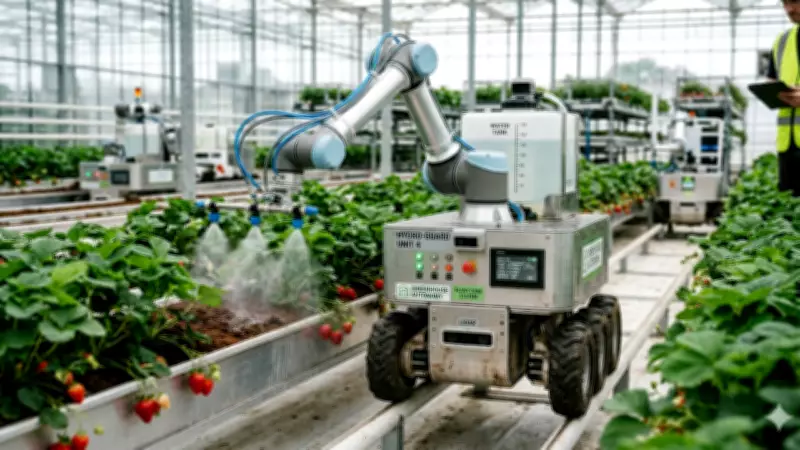
Smart Robots Revolutionize Farming with Precision Irrigation Technology
Water scarcity is rapidly emerging as one of the most critical threats facing modern agriculture worldwide. This pressing challenge necessitates the development of innovative solutions to ensure every single drop of water is utilized with maximum efficiency. For decades, traditional irrigation methods have followed a universal approach, watering entire fields uniformly regardless of individual plant needs, leading to significant inefficiencies and substantial water wastage.
Ending the Irrigation Guessing Game
Fortunately, a groundbreaking innovation in agricultural robotics is transforming this outdated paradigm. Scientists have developed an intelligent robotic system capable of determining precisely which trees require watering and which do not. This revolutionary technology centers around small ground-based robots that map soil moisture with unprecedented accuracy.
Researchers from Pennsylvania State University have pioneered a method that deploys these robots into orchards to measure moisture levels for each tree individually, rather than treating entire fields as homogeneous units. This approach addresses one of agriculture's most persistent problems: the diversity of soil properties. Even trees standing adjacent to each other can have dramatically different water requirements based on their specific soil composition and absorption capabilities.

As the research team emphasized, traditional irrigation has always been "a guessing game" where equal watering doesn't guarantee adequate hydration for every plant.
How the Intelligent Watering System Operates
The robotic system employs advanced sensors that detect soil electrical conductance, which provides an accurate measurement of moisture levels. These readings are calibrated using direct soil measurements to ensure precision. During extensive testing conducted from October 2024 through March 2025, researchers reported exceptional results.
Specifically, the system achieved a median error of only 0.039 m³/m³ when evaluating soil moisture, a level considered "acceptable" for agricultural applications. Perhaps even more remarkably, the study found that maintaining just four to six calibration sites per field was sufficient to sustain accurate results. This significantly reduces the infrastructure costs typically associated with soil moisture measurement equipment.
Like many smart agriculture devices, this soil moisture detection technology employs automation to enhance decision-making processes. Previous research on automated irrigation has demonstrated how sensors, robotics, and algorithms collectively play crucial roles in modern farming.
Environmental Impact and the Future of Smart Agriculture
The implications of this technology extend far beyond mere convenience. Over-watering not only wastes precious water resources but also promotes crop diseases, depletes soil nutrients, and can actually damage trees. Precision irrigation, by contrast, ensures each tree receives exactly the water it needs, potentially maximizing crop yields while conserving resources.
With water scarcity becoming increasingly apparent due to worsening drought conditions and global warming, robotic systems like this make it possible to grow the same agricultural products using significantly less water—a concept that was barely conceivable just a few years ago.
Looking ahead, such systems could potentially integrate with other technological innovations to create fully self-sustained watering networks. Artificial intelligence and climate forecasting technologies might complement precision irrigation systems, enabling farms to autonomously adjust their watering responses to changing weather patterns.
Perhaps the most valuable aspect of this technology is its demonstration that perfection in agriculture is achievable. Through robotics and advanced technology, farmers can approach unprecedented levels of resource efficiency and crop optimization.