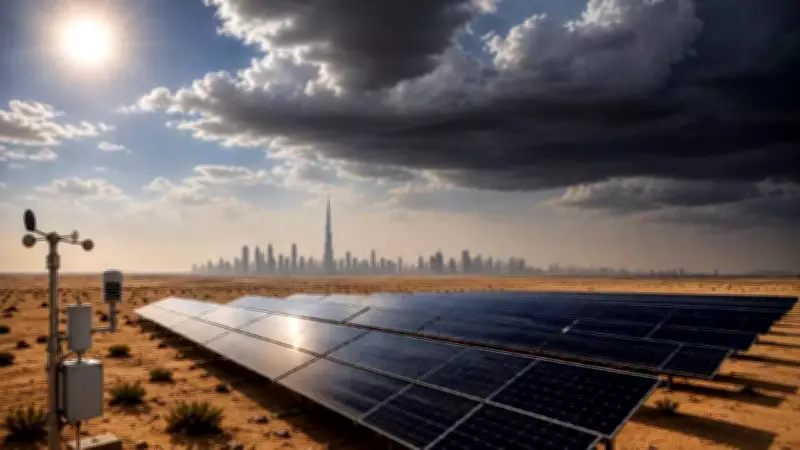
A group of German scientists has spent years examining a possibility that sits at the intersection of renewable energy, weather, and water security: what if vast fields of dark solar panels could change the atmosphere above them enough to help trigger rain? The idea sounds almost backwards, as solar farms are usually discussed as a way of generating electricity in some of the world's driest landscapes, not as a possible source of rainfall.
According to a paper by researchers at the University of Hohenheim in Germany, titled “Scaling artificial heat islands to enhance precipitation in the United Arab Emirates,” the answer may depend largely on scale. Their simulations suggest that once dark artificial surfaces reach a certain size, they begin to influence local weather patterns in ways that smaller installations do not. In the case of the United Arab Emirates, that influence could include an increase in rainfall.
How Giant Solar Power Plants Could Trigger Rainfall in the UAE
The findings come from a modelling study that explored how large low-albedo surfaces, including solar photovoltaic installations, interact with the hot desert atmosphere and the moisture carried inland by sea breezes. The team tested a series of hypothetical artificial black surfaces ranging from 10 kilometres by 10 kilometres to 50 kilometres by 50 kilometres. These surfaces were designed to represent extremely dark installations similar in behaviour to large solar farms or other low-reflectivity structures spread across desert terrain.

What emerged was a clear threshold effect. Small installations produced little change. Larger ones were different. The paper reports that surfaces measuring 20 kilometres across or more consistently enhanced rainfall in the simulations, while the 10-kilometre version had only a minimal impact.
The Science Behind the Phenomenon
The reason lies in the way dark surfaces absorb sunlight. Desert soils already become extremely hot during summer afternoons, but darker materials absorb even more energy. That extra heating warms the air immediately above the surface, making it more buoyant. As the heated air rises, it can help weaken atmospheric barriers that normally suppress cloud formation.
“The addition of large ABSs acts to amplify these factors by pre-conditioning the atmosphere,” according to the authors of the paper, referring to artificial black surfaces. They found that the extra heating reduced convective inhibition, strengthened convergence zones, and encouraged upward motion in the atmosphere.
How UAE Solar Power Plants Influence Cloud Formation and Rainfall
The study was focused on the UAE, where moisture from the Arabian Gulf frequently moves inland during summer as a sea breeze. On many days that moisture is present, but not quite enough to produce widespread rainfall over the desert plains. The simulations suggest that giant dark surfaces could tip the balance.
As the sea breeze approaches, the heated air above the artificial surfaces creates stronger vertical movement. Moist air arriving from the coast is then lifted more efficiently, increasing the likelihood of cloud development and thunderstorms. The effect was not uniform from one day to another. Weather conditions still mattered. Some simulated days produced stronger rainfall responses than others. Yet the researchers repeatedly observed the same general pattern: larger surfaces generated stronger atmospheric responses. Rainfall enhancement increased steadily as the size of the installation grew. The biggest simulated surfaces produced the greatest changes in convection, vertical air motion, and precipitation.
Can Solar Power Plants Become Part of the UAE's Water Strategy?
The paper was motivated partly by the UAE's long-running search for additional water resources. Water scarcity remains a major challenge across the Gulf region, where growing demand, limited freshwater supplies, and a warming climate are placing increasing pressure on existing systems. For years, authorities have relied on measures such as desalination and cloud-seeding programmes.

The German researchers explored whether large-scale renewable energy infrastructure might eventually provide a secondary benefit. Their modelling suggested that rainfall increases associated with large artificial surfaces could amount to hundreds of thousands of cubic metres of additional water during favourable rainfall events. Larger installations generated substantially greater gains.
The authors are careful not to present these figures as guaranteed outcomes. The study was based on atmospheric simulations rather than real-world measurements, and many uncertainties remain. Rainfall generated by storms does not automatically translate into usable water supplies, and not all of it would be captured for human use.
Why German Scientists Say More Research Is Needed on Solar Farms and Rainfall
Despite the attention surrounding the idea, the researchers repeatedly stress that further work is needed before any firm conclusions can be drawn. According to the study, advanced weather models are more accurate than field observations. The next challenge is determining whether the same processes occur outside a computer simulation.
The authors argue that large solar farms already being built across the Middle East offer an opportunity to investigate these interactions in real conditions. They also suggest that future projects could combine renewable energy generation with rainfall enhancement if the atmospheric effects can be confirmed. For now, the concept remains a scientific hypothesis supported by modelling evidence rather than direct proof.