

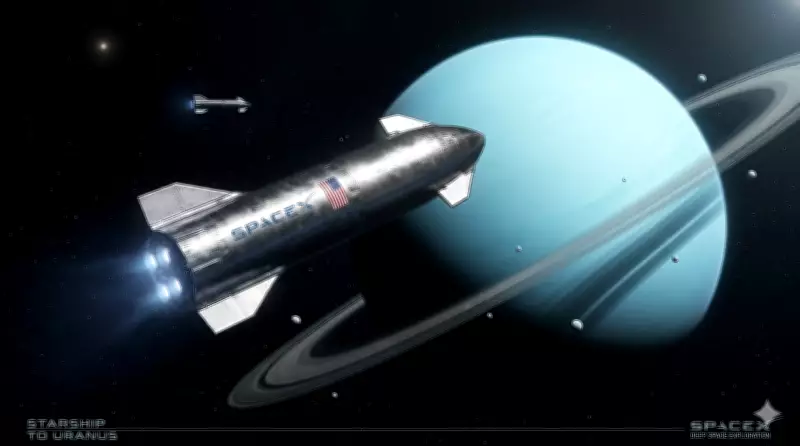
SpaceX Starship Could Revolutionize Uranus Exploration with Drastically Reduced Travel Time
For decades, the immense distance to Uranus has made missions to the ice giant a monumental challenge, typically requiring travel times spanning over a decade. However, a groundbreaking development from SpaceX might soon rewrite this narrative entirely. According to recent research, the company's next-generation Starship rocket could potentially slash the journey to Uranus by more than half, transforming the feasibility of exploring this distant world.
Starship's Orbital Refueling: A Game-Changer for Deep Space Missions
The key to this dramatic reduction lies in Starship's unique design capability for orbital refueling. Unlike conventional rockets that launch with all their fuel onboard, Starship is engineered to be refueled in Earth's orbit after initial launch. This innovative approach allows the spacecraft to depart with fully loaded fuel tanks, enabling more direct and faster trajectories to distant destinations like Uranus.
A study titled 'Starship as an Enabling Option for a Uranus Flagship Mission' conducted by MIT scientists reveals that this approach could enable a spacecraft to reach Uranus in approximately six years. This represents less than half the time required by previous mission concepts using existing rocket technology.

"If refueled in orbit, Starship can launch a spacecraft straight to Uranus," stated Chloe Gentgen, a research scientist at MIT involved in the study. Beyond speed, Starship's substantial size and power provide another crucial advantage: the capacity to transport significantly larger scientific payloads to distant planets, potentially enabling more comprehensive research instruments and experiments.
The Historical Challenge of Reaching Uranus
Uranus presents one of the most formidable distance challenges in our solar system, positioned approximately 19 times farther from the Sun than Earth. This vast separation has historically translated into exceptionally long mission durations. NASA's Voyager 2 probe, launched in 1977, required over nine and a half years just to perform a brief flyby of the planet in 1986—and that mission benefited from favorable planetary alignments.
More contemporary mission designs using powerful rockets like SpaceX's Falcon Heavy have projected travel times of around 13 years, relying heavily on complex gravity-assist maneuvers around other planets to conserve fuel. These extended durations create multiple practical challenges: they dramatically increase mission costs, risk losing experienced personnel over time, and delay scientific discoveries by years or even decades.
Why Accelerated Access to Uranus Matters Scientifically
Uranus remains one of the least explored planets in our solar system, with our knowledge largely limited to data gathered during Voyager 2's brief encounter nearly four decades ago. Yet scientifically, Uranus presents extraordinary mysteries worth investigating. The planet rotates on its side with an extreme axial tilt, possesses unusual and complex magnetic fields, and may harbor subsurface oceans on some of its moons—environments that could potentially support life.
The 2022 Planetary Science Decadal Survey, a consensus report from the scientific community, identified a Uranus orbiter and probe mission as the highest priority for flagship planetary science missions. Halving the travel time to Uranus would provide numerous benefits: accelerating scientific discoveries, reducing mission risks associated with long durations, enabling observations during specific planetary alignments, and potentially paving the way for more ambitious missions to Neptune and beyond.
Starship represents more than just another rocket; it could fundamentally alter humanity's approach to deep space exploration. If the predictions from MIT researchers prove accurate, reaching distant worlds like Uranus may become significantly more accessible within our lifetimes.






