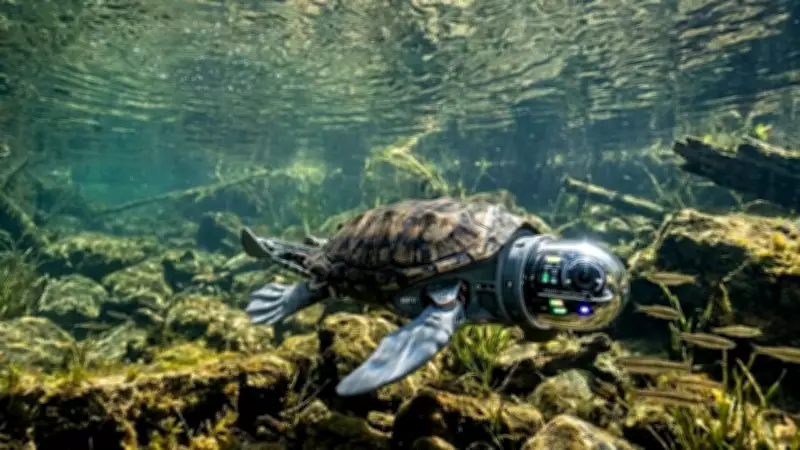
A 15-year-old Canadian named Evan Budz has taken on a significant challenge in marine conservation with his invention of the Bionic Underwater Robotic Turtle (BURT). This innovative device fills a critical gap by incorporating the natural swimming kinematics of snapping turtles, creating an autonomous vehicle capable of monitoring and assessing delicate aquatic areas. Unlike conventional heavy submersibles, BURT moves gently through coral reefs and freshwater habitats without disturbing local wildlife. It features high-quality cameras and machine-learning models to identify invasive species and coral bleaching with a 96 percent detection accuracy rate, as reported by the Canadian Broadcasting Corporation (CBC). By leveraging affordable hardware and biomimicry alongside advanced data collection methods, Evan has paved the way for everyday people to actively participate in environmental protection and combat climate change.
The Bionic Underwater Robotic Turtle Invention by Evan Budz
Evan Budz, a 15-year-old from Dundas, Ontario, created the Bionic Underwater Robotic Turtle, named BURT. He conceived the idea while camping at the Great Lakes and observing snapping turtles moving smoothly and efficiently. Unlike traditional underwater drones that rely on noisy propellers, which can harm marine life, Evan's invention offers a gentler approach. His robot mimics nature by using soft-fin technology, allowing it to move quietly through water. This design enables exploration of areas with delicate aquatic life and coral reefs without disturbing or damaging them.
How BURT Tracks Ecological Risks
BURT's primary function is to identify environmental dangers, made possible by its advanced sensors and artificial intelligence. Budz integrated a machine-learning model directly into the robot, training it to recognize issues such as coral bleaching, plastic waste, and invasive species with an impressive 96 percent accuracy. Once the system operates autonomously, researchers can collect crucial real-time information about underwater threats. This high level of accuracy is essential for conservationists who must respond swiftly to mitigate the effects of climate change and human activities on delicate freshwater and marine environments.

Recognition of BURT's Advanced Monitoring Potential
Evan Budz has gained international recognition, representing Canada at the European Union Contest for Young Scientists (EUCYS). He stood out among hundreds of global competitors with a project that earned acclaim for its practical applications in environmental science and engineering. At a young age, Budz's achievements highlight how student-driven innovations are increasingly important in addressing complex global issues. EUCYS recognized his work as proof of the bionic turtle's advanced technical design and its potential impact on large-scale ecological monitoring.
BURT Is Changing Environmental Science
The bionic turtle represents more than its current capabilities; it signifies a shift toward cheaper and eco-friendly tools for studying the ocean. Budz built a prototype using off-the-shelf components and accessible materials, demonstrating that significant scientific work does not always require millions of dollars. Looking ahead, this young inventor aims to enhance the robot by adding features that enable autonomous operation and more extensive data collection. His project serves as a blueprint for environmental monitoring, illustrating how biomimetic principles can help protect the planet's most vulnerable underwater areas and wildlife.
This article was contributed by the TOI Science Desk, a team of journalists dedicated to delivering captivating science news and features to readers of The Times of India.