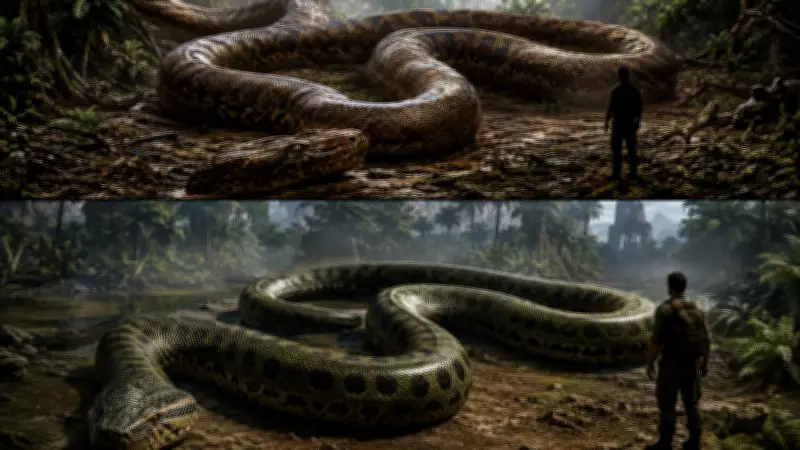
For over two decades, Titanoboa cerrejonensis held the title of the largest snake ever discovered. This Colombian giant, unearthed in 2002, was a record-breaker. However, in 2024, paleontologists in India uncovered fossils that challenged its reign: remains of a snake named Vasuki Indicus, after the snake king associated with the Hindu deity Shiva, as reported by Reuters. The question is simple yet impossible to answer with absolute certainty: which snake was actually larger?
The Reign of Titanoboa
Titanoboa roamed the Earth approximately 60 million years ago during the Paleocene epoch. Fossils indicate it reached lengths of 42 to 47 feet and weighed around 1,100 kilograms, roughly 2,500 pounds. It inhabited tropical rainforests in what is now Colombia, navigating swamps and hunting fish in semi-aquatic environments. For years, it remained the undisputed champion of prehistoric serpents.
The Rise of Vasuki Indicus
Then came Vasuki Indicus, discovered in a lignite mine in Gujarat, India. This newly identified ancient snake lived around 47 million years ago. Based on fossilized vertebrae, researchers estimate it stretched between 36 and 50 feet in length. At the upper end, it could potentially be longer than Titanoboa. However, paleontologist Sunil Bajpai from the Indian Institute of Technology Roorkee told Reuters that while the estimated body length of Vasuki is comparable to Titanoboa's, "the vertebrae of Titanoboa are slightly larger than those of Vasuki. However, at this point, we cannot say if Vasuki was more massive or slender compared to Titanoboa."

Vertebrae Size and Body Mass
Several reports indicate that Vasuki has the second-largest known vertebrae after Titanoboa, giving Titanoboa a slight edge in raw material. But vertebrae size does not necessarily tell the whole story about overall length or mass. A slender snake with smaller bones could potentially be longer than a thicker-bodied snake with larger vertebrae. The difficulty lies in the fact that scientists do not have complete fossils. They compare vertebrae sizes to modern snakes like anacondas and pythons to extrapolate the whole animal, which works reasonably well but carries uncertainty.
Lifestyle Differences
The difference in lifestyle also matters. Titanoboa was primarily a fish-eater, adapted for semi-aquatic hunting in swampy environments. In contrast, Vasuki was likely more terrestrial, a slow-moving ambush predator that hunted catfish, turtles, crocodiles, and even primitive whales on land.
The Verdict
So which was bigger? The most honest answer is that Titanoboa probably wins on sheer mass, at roughly 2,500 pounds. However, Vasuki might have been slightly longer, with upper estimates reaching 49 to 50 feet compared to Titanoboa's 42 to 47 feet. It is a close call between two monsters that fundamentally redefine what "large" means.