

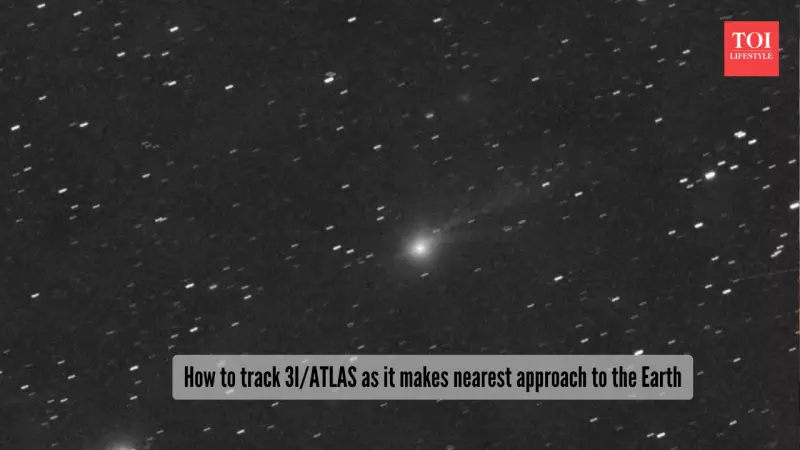
The arrival of an interstellar visitor like comet 3I/ATLAS is akin to hitting the cosmic jackpot, sparking both scientific excitement and wild public speculation. Since its detection, this enigmatic object has been the subject of intense telescopic observation and unfounded theories about extraterrestrial origins, which space agencies have been quick to dismiss. As it prepares for its nearest pass by our planet, skywatchers and scientists alike are gearing up for a rare celestial event.
What Is The 3I/ATLAS Interstellar Comet?
Discovered in July 2025 by the ATLAS telescope in Chile, 3I/ATLAS is the third confirmed object from beyond our solar system. Following in the footsteps of 'Oumuamua (2017) and Comet Borisov (2019), it earned the designation "3I" for "Third Interstellar." NASA's Jet Propulsion Laboratory and the Minor Planet Center confirm it originated from the direction of the constellation Sagittarius. Unlike rocky asteroids, this is a true comet, composed of an icy nucleus that releases gas and dust, forming a glowing coma and characteristic tails.
NASA Images and How to Track Its Approach
NASA released stunning images of the comet on November 19, 2025, showcasing its active coma. The Hubble Space Telescope captured it on November 30 from approximately 178 million miles away. Adding to the data, the European Space Agency's JUICE probe, near Jupiter, took pictures between November 2 and 25, catching the comet in a hyperactive state after its solar close approach.

The comet's closest approach to Earth occurs on December 19, maintaining a safe distance of about 170 million miles. It will be too dim for naked-eye viewing, requiring at least binoculars or a small telescope. Look for it in the pre-dawn skies near the constellations Virgo and Leo, with visibility extending into spring 2026. For real-time tracking, you can use:
- NASA's Eyes on the Solar System tool.
- The Virtual Telescope Project's live stream.
Facts, Figures, and Debunking Alien Theories
Data from Hubble and ESA suggest the comet's nucleus is between 1,400 feet and 3.5 miles wide. At its discovery, it was racing through space at nearly 137,000 miles per hour, speeding up as it neared the Sun before slowing on its outbound journey. The observed outbursts of gas and dust confirm its natural cometary behavior.
Despite its ordinary composition, the comet fueled conspiracy theories, amplified by discussions from Harvard scientist Avi Loeb, suggesting it could be an alien probe. NASA has categorically rejected this claim. In November 2025, Associate Administrator Nicola Fox stated, "We certainly haven't seen any technosignatures." Observations from Hubble, the James Webb Space Telescope, and ESA confirm it is simply a natural body of ice and rock from another star, with zero evidence of artificial technology.
This close pass offers a fleeting opportunity to witness a genuine piece of another star system, a reminder of the dynamic and wondrous nature of our cosmic neighborhood.






