

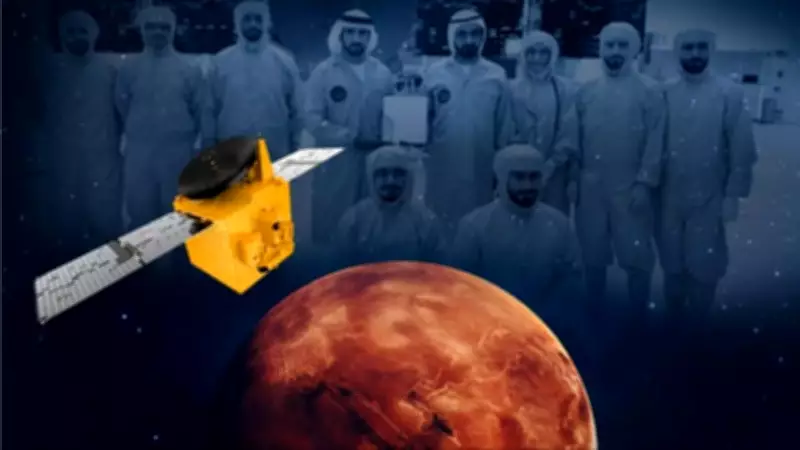
UAE Announces Major Extension of Emirates Mars Mission Through 2028
The United Arab Emirates Space Agency has made a groundbreaking announcement, revealing a significant extension of its Emirates Mars Mission (EMM), widely known as the Hope Probe. The mission will now continue operations all the way through 2028, representing a three-year extension beyond its original timeline. This decision marks a pivotal moment in the UAE's ambitious space program and global scientific collaboration.
Official Announcement and Leadership Support
The extension was formally announced by Dr. Ahmad Belhoul Al Falasi, UAE Minister of Sports and Chairman of the Space Agency, during a press briefing held in Dubai. The announcement received strong backing from Sheikh Hamdan bin Mohammed bin Rashid Al Maktoum, Crown Prince of Dubai and Chairman of the Space Council, highlighting the mission's strategic importance to national leadership.
Mission Achievements and Scientific Contributions
Originally launched in 2020 and successfully entering Martian orbit in February 2021, the Hope Probe was initially designed as a two-year mission focused on studying Martian weather patterns and atmospheric dynamics. Specifically, the mission aimed to investigate the complex interaction between Mars' lower and upper atmosphere. However, after more than five years in orbit, the probe has dramatically exceeded all expectations.

The scientific achievements have been remarkable:
- Collection of approximately 10 terabytes of valuable scientific data
- Groundbreaking research contributions to understanding Mars' climate systems
- Important discoveries about Martian auroras and the planet's small moon Deimos
- Rare recording of ultraviolet images of the interstellar object 3I/ATLAS in October 2025
The interstellar object observation represents a particularly significant achievement, as 3I/ATLAS was only the third known interstellar object detected passing through our solar system. The Hope Probe captured these images using its sophisticated onboard instruments while positioned in Martian orbit, demonstrating the mission's versatile capabilities.
Scientific Implications of the Extended Mission
Extending the mission through 2028 will provide scientists with unprecedented opportunities to observe seasonal and long-term changes in the Martian atmosphere. This extended observation period is crucial for understanding not only Mars but also comparative climate systems across different planets. According to space officials, this prolonged research phase will significantly deepen humanity's knowledge of planetary atmospheres.
The extended mission will specifically focus on:
- How planetary atmospheres evolve over time
- How they respond to solar influences and radiation
- Comparative studies that have implications for understanding Earth's own climate systems
Global Collaboration and Data Sharing
The mission's success has underscored the UAE's growing role in global space research. Scientific data from the Hope Probe has been shared widely with researchers at more than 200 institutions worldwide, enhancing collaborative research efforts that transcend any single nation's space program. This open approach to data sharing has fostered unprecedented international cooperation in planetary science.
Strategic Vision for UAE's Space Ecosystem
The mission extension reflects the UAE's comprehensive long-term strategic vision for its space sector. National leaders view the Mars mission not merely as a scientific achievement but as a powerful catalyst for multiple national priorities:
- National Innovation: Driving technological advancement and research capabilities
- Education: Inspiring STEM (science, technology, engineering, and mathematics) education across the region
- Economic Diversification: Supporting the transition to a knowledge-based economy
Since the mission's inception, the UAE's space ecosystem has experienced rapid expansion:

- Significant growth in aerospace programs at universities
- A tripling of space-related entities between 2020 and 2025
- Increasing participation and investment from the private sector
Future Missions and Capacity Building
Officials have emphasized that extending the Hope mission maximizes the return on the nation's space investment while building invaluable operational experience. This experience will directly support future deep-space missions, most notably the ambitious Emirates Mission to the Asteroid Belt scheduled for launch in 2028. This subsequent mission aims to explore multiple asteroids located between Mars and Jupiter.
Beyond pure scientific research, the extended mission serves as a powerful inspiration and capacity-building initiative. It has generated tremendous interest in STEM education across the UAE and the broader region, motivating thousands of students and young researchers to pursue careers in space exploration and related technological fields.
Historic Milestones and Future Positioning
The Emirates Mars Mission represents a series of historic achievements. The UAE became the first Arab nation and only the fifth country overall to successfully reach Mars, a milestone celebrated internationally. The mission extension signals that the UAE's role on the interplanetary stage extends far beyond symbolic achievement—it represents active, sustained contribution to scientific discovery.
In addition to ongoing data collection, the mission's legacy continues to shape the UAE's comprehensive space strategy. This includes accelerating investment in space technologies, forging international partnerships, and advancing research that positions the country among the world's emerging space powers by 2031. These developments align with broader national goals to diversify the economy and foster a knowledge-driven future that leverages scientific excellence for sustainable development.





