

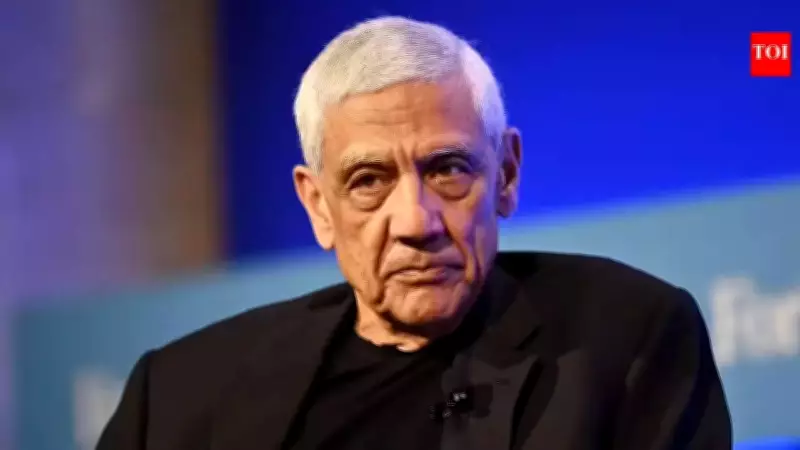
There is a version of success that looks clean and inevitable in hindsight: like a startup that became a billion-dollar company; a technology that changed an industry; a bet that paid off spectacularly. What that version tends to hide is everything that came before: the wrong turns, the failed attempts, the moments when it felt like the whole thing could have collapsed and almost did. Vinod Khosla knows that version well. And he does not buy it.
Vinod Khosla's Philosophy on Failure
According to Khosla, people are taught to aim for success, to minimise risk, and to have a plan. But there is something almost the opposite: that the capacity to absorb failure, to attempt things that might not work, and to keep going anyway, is the foundational trait for achieving great success.
Quote of the Day by Vinod Khosla: "Your willingness to fail is what will let you succeed."

Who Is Vinod Khosla?
Vinod Khosla is not someone who speaks about failure from a comfortable distance. He co-founded Sun Microsystems, one of the defining technology companies of the 1980s and 1990s. He later built Khosla Ventures, one of Silicon Valley's most influential investment firms, known specifically for backing audacious bets in areas like clean energy, healthcare, and artificial intelligence (AI). What distinguishes Khosla from many investors is his appetite for the genuinely difficult. He has repeatedly said he is more interested in funding ideas that might fail spectacularly than ones that are likely to succeed modestly. It is a deliberate philosophy built on a clear-eyed understanding of how big things actually get built. His quote on failure is a distillation of what he seems to have observed over decades of watching companies succeed and collapse, and, most importantly, what separates the ones that ultimately made something meaningful from the ones that played it safe and disappeared quietly.
What the Quote Actually Means
The quote is not saying that failure is good. It is saying that the willingness to risk failure is good, and that without it, the kind of success worth having is largely out of reach. This distinction matters. There is a difference between being reckless and being willing to attempt something with an uncertain outcome. The person who starts a company knowing it might not work; the researcher who pursues a hypothesis that most of their peers think is wrong; the engineer who proposes a solution that has never been tried before—all have this one thing in common. All of these people are making themselves vulnerable to failure, which is precisely what puts them in a position to achieve something that the cautious, the risk-averse, and the comfortable never will. The logic is simple once you see it: the biggest opportunities almost always come with the biggest uncertainty.
Most people are not afraid of failure in the abstract. They are afraid of what comes with it: the judgment of others, the loss of resources, the damage to reputation, the simple psychological weight of having tried hard at something and not succeeded. The most successful founders, investors, and innovators tend to share this quality. They do not enjoy failing, but they have made peace with the possibility of it—and that peace is what frees them to take the swings that matter.
About the Author: The TOI Tech Desk is a dedicated team of journalists committed to delivering the latest and most relevant news from the world of technology to readers of The Times of India. TOI Tech Desk's news coverage spans a wide spectrum across gadget launches, gadget reviews, trends, in-depth analysis, exclusive reports, and breaking stories that impact technology and the digital universe. Be it how-tos or the latest happenings in AI, cybersecurity, personal gadgets, platforms like WhatsApp, Instagram, Facebook, and more; TOI Tech Desk brings the news with accuracy and authenticity.






