

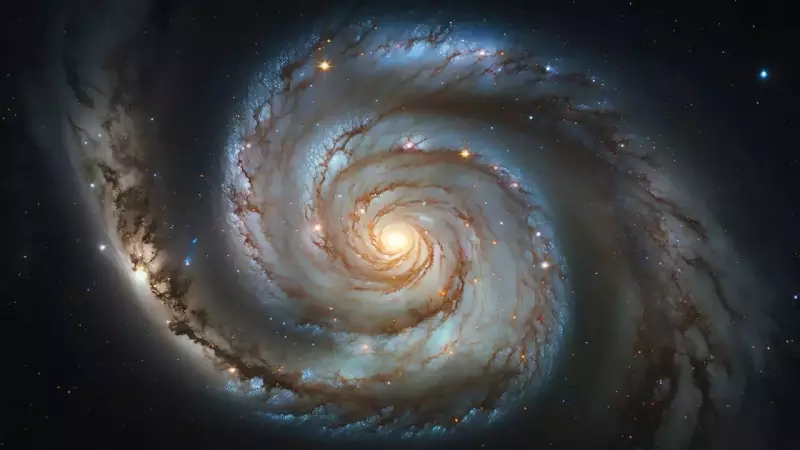
In a discovery that is shaking the foundations of astronomy, the James Webb Space Telescope (JWST) has captured an image of a surprisingly mature galaxy from the universe's infancy. This finding challenges long-held beliefs about the chaotic and disordered nature of the early cosmos.
A Cosmic Anomaly Named Alaknanda
The galaxy, named Alaknanda, is observed as it existed a mere 1.5 billion years after the Big Bang. At this early epoch, scientists expected to see only irregular, clumpy collections of stars. Instead, JWST's sharp infrared vision revealed a grand design spiral galaxy with sweeping, symmetrical arms and a coherent disc structure. Published in the journal Astronomy and Astrophysics, the research details a galaxy spanning about ten kiloparsecs and boasting a stellar mass equivalent to ten billion Suns.
The clarity of its spiral form in both ultraviolet and visible wavelengths confirms it is not a messy imitation but a true, well-settled spiral. This level of organisation, typically associated with much older galaxies, suggests that the processes forming such structures happened with astonishing speed.

Why This Galaxy Breaks All The Rules
The existence of Alaknanda directly contradicts many theoretical models. The early universe is thought to have been a turbulent place, where violent gas inflows, explosive star births, and feedback from black holes would rip apart any attempt to form a stable, rotating disc.
Yet, Alaknanda's elegant spiral arms, traced by chains of star-forming regions like "beads on a string," tell a different story. It indicates that the galaxy's gas cooled and organised itself efficiently, preserving angular momentum to create a rotationally supported disc far earlier than deemed possible. Remarkably, it managed this while maintaining a vigorous star formation rate of dozens of solar masses per year.
Reshaping Our Understanding of Galactic Timelines
This single discovery places immense pressure on existing cosmic evolution timelines. If galaxies like Alaknanda could achieve such maturity within 1.5 billion years, it implies that:
- The early universe might have had pockets of surprising stability conducive to rapid organisation.
- Dark matter halos or other external factors may have allowed for quicker disc settling.
- The diversity of galaxy shapes in the young cosmos was far greater than simulations predict.
Consequently, astronomers may need to significantly revise models, treating the emergence of ordered structures not as a late-stage phenomenon but as a process that could begin remarkably early.
The Future of Cosmic Exploration
Alaknanda acts as a beacon, signalling that other such well-ordered galaxies are likely hiding in the deep past, waiting for JWST's powerful gaze to find them. This discovery underscores the telescope's revolutionary role in reshaping our cosmic narrative.
Future surveys will now scour high-redshift regions with renewed vigour, searching for more early spirals. Each new find will refine our understanding of dark matter, gas dynamics, and the evolutionary pathways that led to the magnificent variety of galaxies we see today. Discoveries like Alaknanda are not just about finding old objects; they are about rewriting the story of our universe's formative years.






