

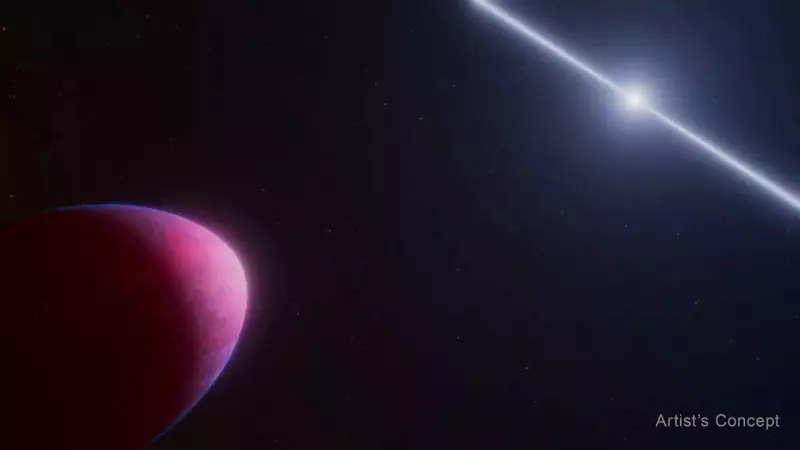
In a discovery that stretches the imagination, NASA's powerful James Webb Space Telescope (JWST) has spotted a truly bizarre world located an astounding 2,000 light-years from Earth. This distant planet, officially named PSR J2322-2650b, defies conventional shapes and atmospheric science, appearing like a cosmic lemon and boasting an air unlike any seen before.
A Planet Forged in Extreme Conditions
The planet's strangeness begins with its parent star. PSR J2322-2650b does not orbit a normal sun-like star. Instead, it circles a millisecond pulsar, which is the incredibly dense, city-sized core left behind after a massive star collapsed. This pulsar packs a mass comparable to our Sun into an object only about the size of a major city, creating an environment of extreme gravity and radiation.
The planet is perilously close to this cosmic powerhouse, orbiting at a distance of just one million miles. For comparison, Earth is nearly 93 million miles from the Sun. This tight orbit means a year on this world passes in a mere 7.8 hours. The proximity creates savage temperature extremes. The side perpetually facing the pulsar broils at a scorching 3,700 degrees Fahrenheit, while the far side is a relatively cooler, yet still hellish, 1,200 degrees Fahrenheit.

The Mystery of the Lemon Shape and Carbon Air
The immense gravitational pull from the super-dense pulsar is so powerful that it physically stretches the Jupiter-sized planet. This tidal force distorts its sphere into an oblong, lemon-like shape, a phenomenon far more dramatic than anything seen in our solar system.
Even more puzzling is the atmosphere revealed by Webb's infrared instruments. While scientists commonly find water vapour or methane in exoplanet atmospheres, this world's air is dominated by carbon compounds like C2 and C3, along with helium. Crucially, it shows a stunning lack of oxygen and nitrogen. Under such intense heat, carbon atoms would normally bond with these elements, but their absence points to an atmosphere that is almost purely carbon-based.
Webb's data suggests the presence of sooty carbon clouds. Deeper within the planet, under crushing pressure and heat, carbon could potentially crystallize into diamonds that rise and mix with the helium. This could explain the carbon abundance, but it leaves a major formation mystery unsolved. Standard models of planet birth cannot easily account for such a chemically pure carbon environment, presenting a fresh puzzle for astrophysicists.
Why This Discovery is a Game-Changer
This observation marks a significant milestone in exoplanet science. It provides the first detailed look at the atmosphere of a world orbiting a pulsar, a category previously shrouded in mystery. The findings demonstrate the JWST's unparalleled ability to analyse the chemical makeup of distant worlds, even in such hostile environments.
The existence of PSR J2322-2650b challenges textbook theories of how planets form and evolve. Its resilience under constant gravitational squeezing and intense radiation also offers new insights into the structural limits of planetary bodies. As the James Webb Space Telescope peers deeper into the cosmos, it continues to uncover extreme worlds that force us to rewrite our understanding of the universe's diversity.






