

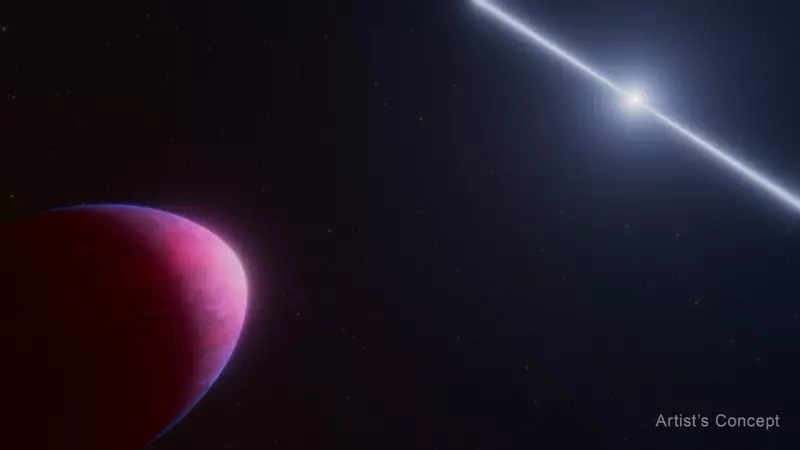
In a groundbreaking discovery that is reshaping our understanding of planetary science, NASA's James Webb Space Telescope (JWST) has provided unprecedented details about a highly unusual exoplanet. This finding offers scientists a deeper look into one of the most extreme and bizarre planetary systems ever observed in our universe.
A World of Dark Clouds and Rare Gases
The planet, designated PSR J2322-2650b, is roughly the size of Jupiter. It orbits a pulsar—a rapidly spinning neutron star—at an incredibly close distance of about one million miles, completing a full revolution every 7.8 hours. While astronomers had previously identified the planet using pulsar timing methods, JWST's powerful infrared instruments have now unveiled the shocking secrets of its atmosphere and physical nature.
What makes this exoplanet extraordinary is its atmospheric composition, which is extremely rare in the known cosmos. Contrary to the water vapor, methane, or carbon dioxide commonly found on other worlds, the atmosphere of PSR J2322-2650b is primarily composed of helium and carbon molecules. Scientists believe the clouds in this alien sky would appear dark, almost sooty, due to the carbon-rich chemicals present.

The discovery left the research team stunned. "This was an absolute surprise," said study co-author Peter Gao of the Carnegie Earth and Planets Laboratory in Washington, in a NASA statement. "I remember after we got the data down, our collective reaction was, 'What the heck is this?' It's extremely different from what we expected." This unique atmosphere directly challenges existing models of planetary chemistry and forces scientists to ask new questions about how planets form and evolve.
Surviving the Unsurvivable: A Planet's Extreme Tale
PSR J2322-2650b exists in one of the harshest environments imaginable for a planet. Pulsars are fast-rotating stellar corpses with immensely powerful magnetic fields, emitting radiation that typically strips away planetary atmospheres. Yet, against all odds, this world has not only survived but has maintained a very dense, carbon-rich atmosphere.
The planet's ordeal doesn't end there. Its extreme proximity to the pulsar subjects it to intense gravitational forces, warping its shape. Scientists report that PSR J2322-2650b is so distorted it has taken on an elongated, lemon-like form, ranking it among the most misshapen planets ever found. Adding to its uniqueness, it orbits a stellar remnant, unlike most exoplanets that circle active, main-sequence stars.
Webb's Revolutionary Eye on the Cosmos
The detailed characterisation of PSR J2322-2650b showcases the revolutionary capabilities of the James Webb Space Telescope. Its unparalleled sensitivity in the infrared spectrum allows scientists to perform precise chemical analyses of exoplanet atmospheres light-years away. In this case, favourable radiation conditions enabled researchers to study the planet's chemistry in detail, contradicting prior assumptions about what was possible to observe.
Every new discovery from JWST, like this one, adds incredible diversity to our catalogue of known planets. PSR J2322-2650b stands as a powerful testament that planets can not only form but also persist in environments once deemed utterly uninhabitable. Further study of this remarkable world promises to unlock more secrets about planet formation, exotic atmospheric compositions, and survival in the universe's most inhospitable corners. It is a vivid reminder that our cosmos is still full of astonishing surprises waiting to be uncovered.






