

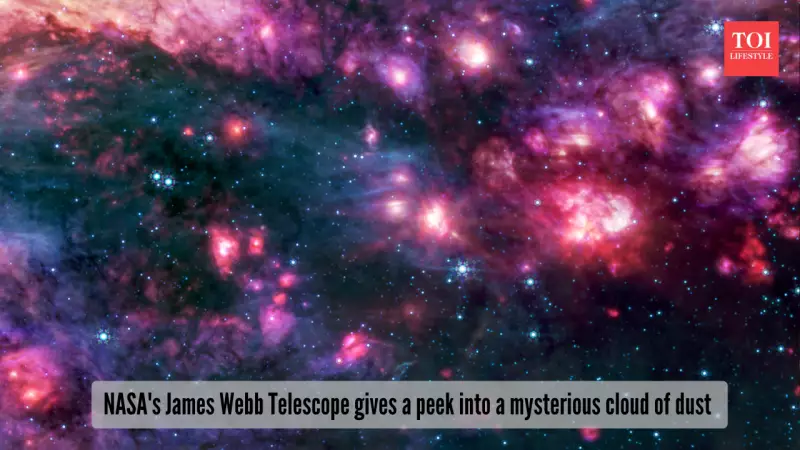
In a stunning revelation, NASA's James Webb Space Telescope has turned its powerful gaze towards the chaotic heart of our Milky Way galaxy, capturing unprecedented details of a massive stellar nursery. The target is Sagittarius B2 (Sgr B2), a giant molecular cloud located a mere 26,000 light-years from Earth, near the galaxy's supermassive black hole.
A Cosmic Nursery Defying Expectations
Spanning an immense 150 light-years and containing between 3 to 10 million times the mass of our Sun in gas and dust, Sgr B2 is a powerhouse of star creation. According to a 2025 NASA release, this region presents a unique puzzle for astronomers. Despite holding only about 10% of the gas in the galactic center's Central Molecular Zone, it is responsible for birthing nearly half of all stars in that tumultuous area.
Researchers from the University of Florida, analyzing the new Webb data, found that Sgr B2 forms stars at a rate of 0.04 solar masses per year. This accounts for almost half of the total star formation in the entire zone, challenging standard theories where more available gas directly correlates to more stars.

Webb's Infrared Eye Pierces the Dust
The telescope's Mid-Infrared Instrument (MIRI) delivered the captivating images, showing glowing clumps in pink, red, and purple hues. These colours mark active sites where new stars are being born, set against dark regions of thick dust that block mid-infrared light.
Complementary near-infrared views, however, allow astronomers to peer through this cosmic veil. They reveal young, brilliant stars piercing through their dusty cocoons. The combined data vividly illustrates the dynamic interactions between gas, dust, and newborn stars. Notably, radiation from these infant stars escapes through outflow cavities in a region known as Sgr B2 North.
Extreme Environment Fuels Unique Chemistry
The extraordinary efficiency of star birth in Sgr B2 is likely driven by the extreme conditions of its location. Sitting just a few hundred light-years from the supermassive black hole Sagittarius A*, the cloud is subjected to intense gravity, fierce radiation, and powerful turbulence.
Scientists suggest that the complex chemistry observed in the redder clumps of the cloud may help cool the gas, making it easier for it to collapse under its own gravity and form stars. This process appears to be supercharged by the unique galactic core environment.
The Webb observations have also uncovered new H II regions—bubbles of ionized gas around massive young stars—that were missed by previous radio telescope surveys. This hints at a hidden population of massive stars and reveals sharp edges of the cloud illuminated by recombination lines of gas.
These findings build upon earlier work, such as a 2018 study by Ginsburg et al., which found that over a third of stars in Sgr B2 form in bound clusters. The new Webb data provides spectacular visual proof and deeper insight, aligning with models of how such extreme environments shape galactic evolution. By unveiling the hidden machinery of star birth, the James Webb Space Telescope continues to fuel both scientific discovery and public wonder about our vast universe.






