

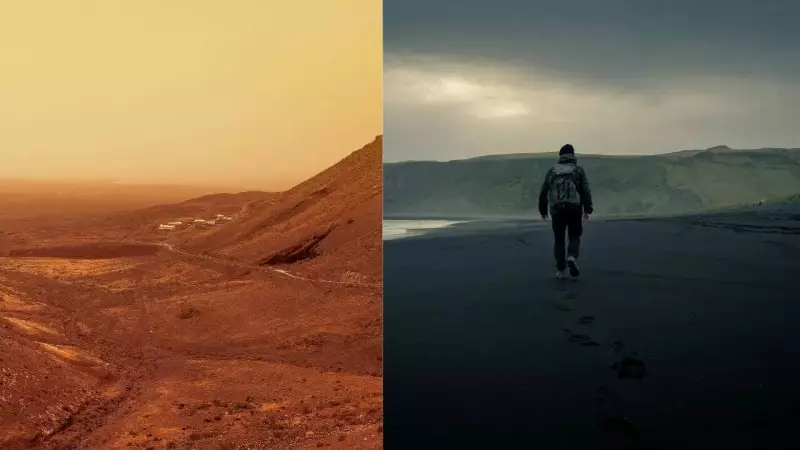
For scientists hunting for signs of ancient life on Mars, the journey often begins not on the red planet, but in the stark, volcanic landscapes of Iceland. This North Atlantic island, with its cracked lava fields, steaming earth, and rivers cutting through fresh black rock, serves as a crucial terrestrial analog for understanding Mars's distant past.
Iceland: Earth's Stand-In for the Martian Environment
The connection between the two worlds is more than poetic. Recent images from rovers like Curiosity have revealed intriguing patterns in Martian rock that hint at ancient microbial activity. These potential biosignatures have made the search for life on Mars feel urgent. However, before any definitive digging happens on another planet, scientists practice and test their theories right here on Earth.
Iceland is geologically young and active. Its volcanoes are still shaping the land, and water relentlessly carves through fresh basalt rock. In some areas, glaciers sit almost side-by-side with lava flows. This extreme environment provides a rare glimpse into a world where fire and water interact violently—a state believed to have existed on ancient Mars billions of years ago.

As Mike Thorpe from NASA’s Goddard Space Flight Center has noted, the comparison is practical, not just poetic. Walking along an Icelandic river canyon reveals layers formed by successive volcanic eruptions and later reshaped by flowing water. Mars shows strikingly similar geological layering, frozen in time for eons.
The SWIFT Team's Gruelling Fieldwork in Iceland
The challenge of planetary science lies in interpreting silent rocks. Sedimentary layers hold minerals, gases, and sometimes, traces of life from the time they were formed. On Mars, rover tools are limited, and the immense distance adds layers of uncertainty. In Iceland, however, scientists can get their hands dirty.
This is where the Southwest Iceland Field Team (SWIFT) operates. Their work is physically demanding, involving long hikes through difficult terrain, wading in cold water, and carrying heavy packs of samples. They collect material from riverbeds, lake floors, and hydrothermal vents—places where heat and chemistry mix in complex ways that could mirror ancient Martian conditions.
One key focus is Lake Kleifarvatn. Beneath its calm surface, hydrothermal vents release gases and minerals into the water. The fine sediments that slowly settle there create a chemistry that scientists believe is similar to what existed on Mars around four billion years ago. Samples from nearby areas like Stóra Laxá show carbon dioxide rising from lake sediments, a process of gas movement through rock and water that may have left chemical fingerprints on Mars.
Carbon Clues and the Persistence of Life in Extreme Places
The search for life, as we know it, is fundamentally a search for carbon. Life leaves carbon behind, though it can be hidden within minerals or escaped as gas. Iceland demonstrates how life persists even in hostile environments with cold water, shifting ground, and limited nutrients. Microbes cling to rocks near vents, adapting without fanfare.
This resilience is not proof of Martian life, but it provides critical context. It shows that if life can find a way in Earth's extreme corners, the door remains open for the possibility that ancient Mars, while not welcoming, was not entirely barren either.
The work continues without certainty. Samples from Iceland are meticulously labelled, tested, and questioned. The island does not hand over easy answers but teaches scientists patience. It is a training ground for reading landscapes that have stopped changing, much like the silent surface of Mars.
For now, Mars remains a distant mystery, and Iceland stays cold and restless. Between them lies a profound scientific quest, filled with rocks, water, and the quiet, tantalising possibility that life once left marks just small enough to miss.






