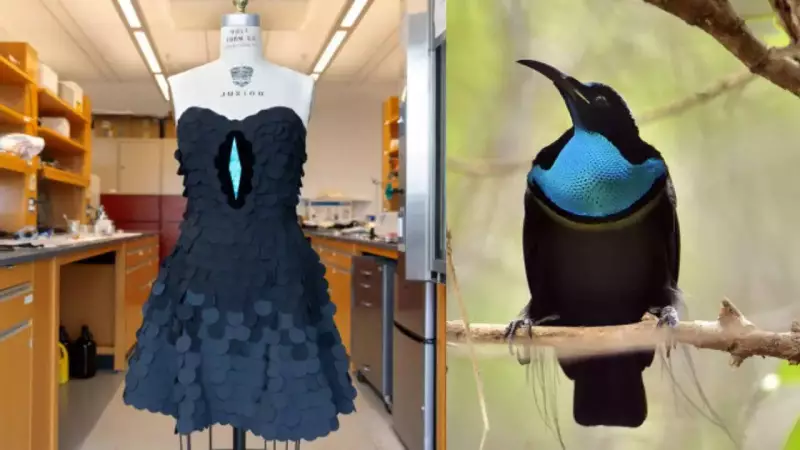
In a breakthrough merging nature's genius with material science, researchers at Cornell University in the United States have engineered the darkest fabric ever known. This revolutionary textile, which absorbs almost all visible light, draws its inspiration from one of nature's most dazzling performers: the magnificent riflebird, a member of the bird-of-paradise family.
Nature's Blueprint: The Secret of the Bird-of-Paradise
The scientific team turned to the natural world for answers, specifically the riflebird's extraordinary plumage. Unlike ordinary black surfaces that use pigment, this bird achieves its profound, velvety darkness through microscopic architecture. Its feathers contain densely layered, microscopic structures called barbules that trap incoming light. The light undergoes repeated internal scattering, leaving virtually nothing to reflect back to the eye.
This biological trick creates an ultrablack backdrop that makes the bird's vivid blue courtship patches appear even brighter. By meticulously studying this feather structure, the Cornell team identified the key features responsible for this extreme light absorption and used them as a template for their human-made fabric.

Engineering Darkness: How Scientists Built the Fabric
The process of recreating nature's magic involved two clever stages. First, the researchers started with a base of simple merino wool knit. This wool was dyed with polydopamine, a synthetic version of melanin, which seeped into the fibres to boost light absorption across the entire visible spectrum. This ensured the darkness came from within the material, not just from a surface coating.
The second, crucial step was plasma etching. This technique gently removed microscopic amounts of material from each fibre's surface, creating a dense forest of nanoscale protrusions or nanofibrils. These nanofibrils mimic the riflebird's feather barbules, forming a complex landscape that captures and disrupts light rays.
The result is astounding. Laboratory measurements show the fabric has an average total reflectance of just 0.13%, meaning it absorbs 99.87% of all visible light. Furthermore, this deep blackness remains consistent even when viewed from angles up to 60 degrees, a significant advantage over many earlier ultrablack materials.
Beyond the Lab: Practical Applications and Future Potential
What sets this development apart is its practicality. Previous ultrablack materials, like those made from carbon nanotubes, are often rigid and fragile, limiting their use. The Cornell fabric, however, is flexible, durable, and based on scalable textile methods. The technique can theoretically be applied to cotton, silk, and other common fibres.
The implications stretch far beyond high-fashion, where it has already been used in a striking strapless dress. The fabric's ability to convert light into heat with extreme efficiency makes it a promising candidate for solar thermal systems, especially for portable or irregularly shaped devices. Its near-total light absorption also opens doors for advanced optical or thermal camouflage and applications in museums and labs that require environments free from stray light.
The Cornell team has filed for a patent and is exploring commercialisation. This biomimetic innovation, detailed in their published study, stands as a powerful example of how natural systems can guide us toward more efficient, sustainable, and visually transformative technologies.