

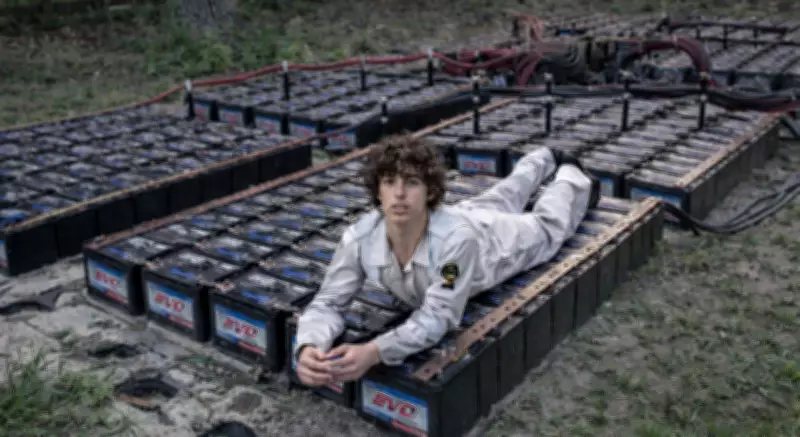
YouTuber's Extreme 400-Car-Battery Experiment Unleashes Over 150,000 Amps
In a spectacular display of backyard engineering, a YouTuber known for pushing the boundaries of high-voltage experimentation has completed his most ambitious project yet: wiring together 400 car batteries to create an electrical system capable of generating currents exceeding 150,000 amps.
The "Professional Mad Scientist" and His Two-Month Build
Drake "Styropyro" Anthony, a chemist who describes himself as a "professional mad scientist" and "science maniac," spent two months assembling this colossal power system. The construction required more than 1,000 pounds of copper wiring and a custom-built switch specifically engineered to handle the immense electrical currents that regular commercial components could not withstand.
"The result is unlike anything I have filmed before," Anthony claims, emphasizing the unique nature of this experiment driven by pure curiosity and a desire to explore "the physics of extreme currents."

From 100 to 400 Batteries: Scaling Up to Extreme Levels
This project represents a significant scaling up from Anthony's previous demonstration using 100 car batteries wired in series—a project he had teased for years. By multiplying the battery count fourfold, he created a system that operates at a relatively modest 65 volts but delivers absolutely staggering current levels.
At peak performance, the system regularly exceeds 150,000 amps, with some estimates suggesting total potential output could surpass 160,000 amps. Anthony provides dramatic context for these numbers, explaining that "a single shot from these batteries is comparable to an entire thunderstorm's worth of lightning bolts."
Why Car Batteries Instead of Capacitors?
Given the extreme currents involved, many viewers might expect capacitors to be the power source of choice. Anthony directly addresses this expectation, noting that while most people associate huge currents with capacitors, car batteries don't fall far behind in maximum current capability.
"The benefit with car batteries is that they can dump those currents for far longer than a brief pulse," he explains. This sustained discharge capability became central to his demonstrations, allowing for prolonged experiments rather than momentary bursts of energy.
Dramatic Demonstrations of Extreme Power
The experimental results are nothing short of spectacular:
- A small steel rod placed between the switch contacts glows intensely before vaporizing in a blinding flash
- Metal piping warps and deforms under concentrated energy, with early attempts resulting in complete destruction
- Various materials including titanium, tungsten, bismuth, and copper produce violent reactions and explosive effects
- Magnetic pulses successfully deform and destroy metal pipes
Anthony describes the project as operating on scales "like you'd find in the national lab," though conducted in his own backyard with more creative freedom. "Much of this is just going to be me sticking random stuff in between the contacts to see what happens," he admits.
The Ferrofluid Finale: A 10-Million-Watt Explosion
For the experiment's climax, Anthony pours ferrofluid into the setup, triggering a massive fireball-like explosion that he later describes as "the coolest thing I've ever filmed in my life."
"In the span of a 10th of a second, nearly the entirety of the dish of ferrofluid was slammed up against the pipe while the total circuit power rose to over 10 million watts," he explains. Remarkably, all 400 car batteries remained intact after this explosive demonstration and can still be used for other purposes.
Safety First Despite the Extreme Nature
Despite the project's seemingly reckless appearance, Anthony insists he approaches everything with careful risk assessment. "I know this must come off as the most ironic thing I've ever said," he acknowledges, "but I don't approach anything potentially dangerous without fully understanding and mitigating the risks at hand."

He emphasizes that even a single car battery can cause serious harm with improper handling and explicitly warns viewers against attempting to replicate his experiments. This caution comes amid Anthony's sometimes fraught relationship with YouTube, where some of his extreme projects have faced demonetization or removal due to safety concerns.
Pushing Boundaries in the Social Media Age
Anthony, whose previous video titles include "Building a Fire Death Machine Using Soviet Military Tech" and "My homebuilt 200W LASER BAZOOKA!!!!" continues to redefine what high-voltage experimentation looks like in the digital era. His latest project serves as both a striking "do not try this at home" warning and a remarkable demonstration of how much energy can be extracted from commonplace car batteries when scaled to extremes.
The 400-battery system represents not just scientific curiosity but also a testament to custom engineering, with Anthony forced to build his own heavy-duty switching mechanism since no commercially available switch could withstand such enormous currents. As he puts it: "With these batteries, I can pull electrical currents far beyond the typical lightning strike, and for much longer durations too."





