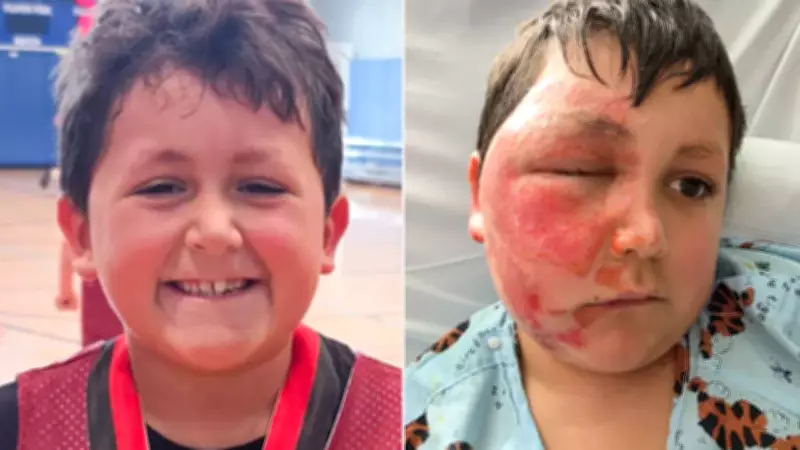
The perils of viral social media trends have been thrust into the spotlight once more following a harrowing incident involving a nine-year-old boy. Caleb Chabolla sustained severe burns while attempting a challenge popularized on TikTok, leading health authorities to issue urgent warnings to parents and children about the hidden dangers lurking online.
A Morning Turned Tragic
According to a detailed statement from Loyola Medicine, the incident occurred on January 20 as Caleb was preparing to leave for school. Inspired by content he had seen on social media, the boy attempted to microwave a Schylling’s NeeDoh Nice Cube, a gel-based sensory toy, with the intention of making it more pliable. The experiment went catastrophically wrong.
As Caleb opened the microwave door to retrieve the toy, the object—filled with a gelatinous material—exploded violently onto his face and hands. His mother, Whitney Grubb, who was in the garage preparing the car, rushed inside upon hearing what she described as a 'blood-curdling scream.'

Emergency Response and Injuries
Whitney immediately tried to wash the burning substance off her son in the shower, but her efforts proved futile. Recognizing the severity of the situation, she rushed Caleb to the emergency room. He was subsequently transferred to the specialized Burn Centre at Loyola Medicine for advanced care.
The injuries were significant. Medical reports confirmed that Caleb suffered second-degree burns on one side of his face and on both hands. His eye was swollen shut, necessitating examination and treatment by an ophthalmologist. The case underscores the immediate and long-term risks associated with such dangerous stunts.
Understanding the Toy and the Trend
The NeeDoh Nice Cube is marketed as a sensory toy designed for stretching, smushing, and squeezing, often used for stress relief. However, its official website carries explicit warnings against heating, freezing, or microwaving the product, clearly stating that such actions can 'cause personal injury.'
Whitney Grubb confirmed that her son learned about microwaving the toy through social media platforms. This revelation highlights a critical gap between manufacturer warnings and the content consumed by impressionable young audiences online.
Paula Petersen, an Advanced Practice Nurse at the burn center, emphasized the gravity of the situation in Loyola's news release. "These trends can be extremely dangerous for young people who are less likely to consider or unable to understand the serious consequences," she remarked, pointing to the developmental challenges in risk assessment among children.
A Recurring and Preventable Danger
Tragically, Caleb's case is not an isolated event. Reports indicate this is at least the fourth such incident involving the microwaving of similar toys. In another documented case, a child heated the toy, touched it, and suffered a burn when her finger penetrated the hot material.
Kelly McElligott, the Burn Outreach Coordinator at Loyola Medical Center Burn Center, provided a broader context. "Whether it’s these toys that clearly have a label that say ‘don’t heat,’ but kids aren’t going to read labels. Or it’s ramen noodles coming out of the microwave that kids spill on themselves, or little kids pulling hot coffee off the counter. These are injuries we see every year at the burn center," she explained.
McElligott further noted that pediatric patients constitute a staggering thirty percent of their cases. "I think it’s every day common things in the home that are burning these kids and we want to make sure that parents should be diligent about what’s in their house," she urged, calling for increased parental vigilance and household safety measures.
A Call for Awareness and Action
This incident serves as a stark reminder of the tangible harms that can stem from online viral challenges. It underscores the need for:

- Enhanced parental supervision of children's social media activities.
- Educational initiatives in schools and communities about digital literacy and physical safety.
- Greater responsibility from social media platforms to monitor and curb the spread of dangerous content.
- Proactive communication between parents and children regarding the risks associated with trending online activities.
The hope is that by sharing Caleb's story and the expert insights from medical professionals, similar tragedies can be prevented in the future, ensuring that curiosity does not lead to catastrophe.