

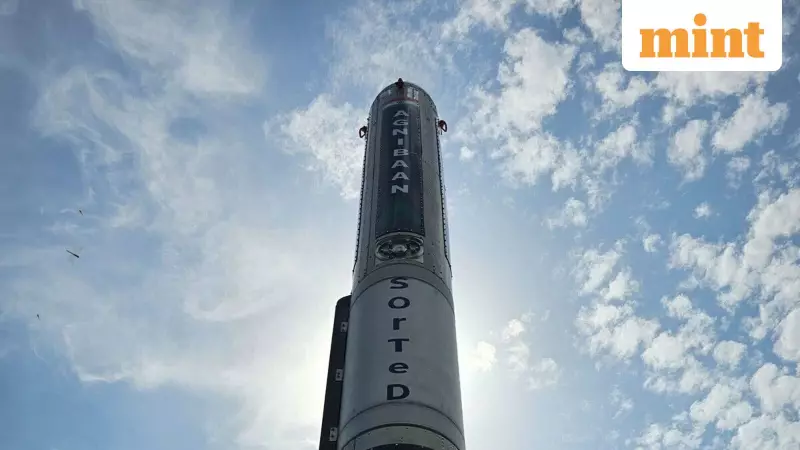
In an ambitious vision for India's private space sector, Chennai-based rocket startup Agnikul Cosmos has set its sights on conducting a staggering 100 launches of its reusable rocket every year by the year 2030. The company, one of India's two private rocket-makers, believes it can achieve profitability within the next two years, but not by following the blueprint of global giant SpaceX.
A Different Road to Reusability and Profit
In a recent interview, Srinath Ravichandran, co-founder and CEO of Agnikul Cosmos, revealed that the company is "very likely" to make its first commercial reusable rocket launch in the coming year. While a fixed date isn't set, preparations are underway. "We're readying our next launch, which will have commercial clients for next year," Ravichandran stated. The plan is to scale up to 12-15 launches annually within two years, building towards the ultimate goal of a launch every three days by 2030.
The financial backbone for this push was strengthened on 22 November, when Agnikul secured $17 million in a Series C funding round, catapulting its valuation to $500 million. This investment is tied to its flagship project: the fully 3D-printed, reusable two-stage rocket named Agnibaan.

Patent-Powered Strategy vs. The SpaceX Model
Agnikul's approach to reusability deliberately diverges from that of Elon Musk's SpaceX. While SpaceX recovers and reuses both booster and first stages of its large rockets, Agnikul is focusing its patented innovation on the small rocket segment. "Such engineering requires massive capital and years of research, and is only feasible in large rockets," explained Ravichandran. "We're not trying to rival them, but bring reusability into the small rockets sector—for which we have already procured a global patent."
The company's method involves vertically landing the booster stage on an ocean barge for recovery. More uniquely, Agnikul plans to work closely with clients to make the rocket's first stage itself act as a satellite base, thereby maximizing utility and revenue from every component. The target cost per mission is under $2 million, a figure Ravichandran is confident will allow profitability even with slim margins.
Navigating Market Skepticism and Competition
This bold vision, however, is not without its challenges. Some industry stakeholders question the economic feasibility of reusability for small rockets like the Agnibaan, which are designed for low-earth orbit (up to 500km) with payloads under 500kg. Chaitanya Giri, a space fellow at Observer Research Foundation, noted that while the technical feat is significant, market risk is a larger hurdle. He added that if successful, Agnikul could establish a new cost structure and become a key global player.
The market Agnikul is entering is becoming increasingly crowded. The company will compete for satellite customers with Hindustan Aeronautics Ltd (HAL), the Indian Space Research Organisation's commercial arm NewSpace India Ltd, and fellow startup Skyroot Aerospace, which also aims for monthly launches by 2027. According to In-Space, India's space economy is projected to generate $3.5 billion in annual revenue from rocket launches by 2033, a pie that will be split among these contenders.
Narayan Prasad Nagendra of Satsearch emphasized that the ultimate test for Agnikul will be proving its capabilities in actual flight, despite its promising differentiators on paper. As India's private space narrative accelerates, Agnikul Cosmos is betting big on its unique, patented technology to carve out a profitable and frequent launch cadence in the skies above.






