

Bengaluru Startup Advances India's First Inflatable Space Habitat with Swiss Tests
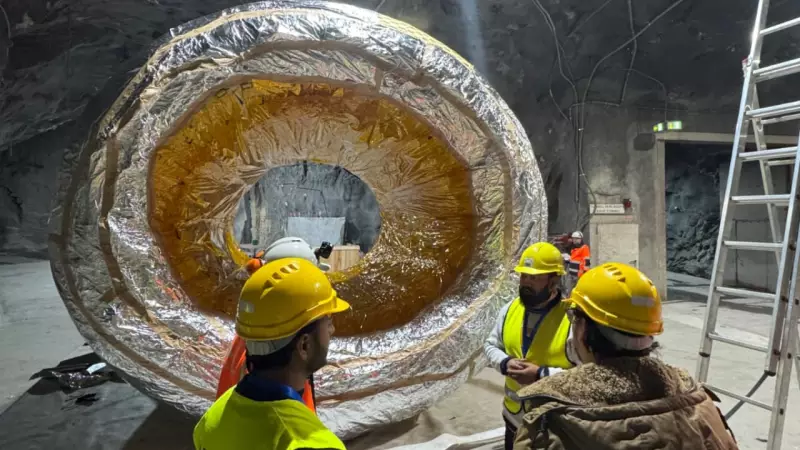
A Bengaluru-based startup has taken a significant stride towards launching India's inaugural inflatable space habitat by successfully completing crucial tests in Switzerland. This milestone was achieved through strategic partnerships, including support from the European Space Agency (ESA).
AntarikshHAB: A Revolutionary Approach to Space Living
Akashlabdhi, a startup incubated at the Indian Institute of Science (IISc), is now preparing to launch a scaled-down version of its inflatable habitat, named AntarikshHAB, in July. This innovative design targets future human missions, addressing longstanding challenges faced by conventional space habitats like the International Space Station (ISS).
"Unlike what was done with ISS, or what is being planned for future space stations, AntarikshHAB can be launched as a compact habitat which will later inflate in space," explained Akashlabdhi CEO Siddarth Jena. "In July, we will be launching a habitat that will be 70 cubic metres while the final habitat we are planning to develop will be around 300 cubic meters."

July Mission: Beyond a Simple Demonstration
The upcoming mission, scheduled for July aboard a vehicle provided by Spanish firm PLD Space, is designed as more than a brief technology demonstration. It will involve deploying the inflatable module in orbit, followed by a controlled de-orbit and atmospheric re-entry.
"Post-flight inspection of recovered material is expected to yield data on degradation, survivability and end-of-life behaviour," Jena noted. "These areas are increasingly important as regulators and space agencies stress responsible operations in low Earth orbit."
Collaborative Efforts with European Partners
For its ambitious programme, Akashlabdhi has forged collaborations with multiple European organisations, including Versuchsstollen Hagerbach (VSH) and the Amberg Group. The initiative is supported through grants and institutional participation from ESA and its partners.
"The programme is supported through grants and institutional participation from Esa and its partners, enabling the establishment of a dedicated Human Habitat Safety and Research & Development facility at VSH Hagerbach in Switzerland," Jena said.
Underground Testing Facility in Switzerland
The underground laboratory, operated by Amberg Group, offers a controlled environment with substantial natural rock overburden. This setup allows for realistic studies of:
- Radiation attenuation
- Structural integrity
- Isolation effects
- Long-duration habitat performance
These conditions are difficult to replicate using surface-based facilities, making this collaboration particularly valuable.
Comprehensive Test Campaign for Technology Readiness
To advance the system to Technology Readiness Level 6 (TRL-6), a comprehensive test campaign was conducted. This included:
- Pressure and leak-before-burst tests on multi-layer flexible structures
- Thermal cycling and accelerated ageing of materials
- Impact testing to simulate micrometeoroid and orbital debris strikes
- Repeated deployment trials to assess the reliability of restraint and inflation mechanisms
These activities are supported by an integrated sensor network feeding into a digital twin framework, enabling real-time correlation between measured performance and predictive safety models.
Academic and Research Contributions
Academic and research participation forms a core pillar of the collaboration. On the Indian side, institutions such as IISc, IIT-Roorkee, and IIT-Delhi are contributing expertise in:
- Space structures
- Materials science
- Systems engineering
- Human-centric design
Swiss participation includes ETH Zurich, EMPA, and the Paul Scherrer Institute (PSI), working alongside ESA-linked research activities to support materials science, radiation studies, and advanced validation methodologies.

Strategic Partnership and Future Implications
Akashlabdhi leads overall habitat architecture, systems engineering, and mission design, while the Amberg Group brings decades of experience in underground safety engineering and certification-oriented testing. This partnership aims to apply proven terrestrial safety principles to the emerging domain of orbital infrastructure.
"The collaboration is an extension of established civil and underground engineering principles into the domain of space systems," said Felix Amberg, president of the board of Amberg Group. "It highlights the value of combining underground safety validation with orbital deployment and recovery."
Beyond the immediate technical goals, this project is seen as a marker of closer cooperation between India and Switzerland, and more broadly with EFTA nations, in high-technology research. This initiative not only pushes the boundaries of space habitation but also strengthens international scientific partnerships.





