

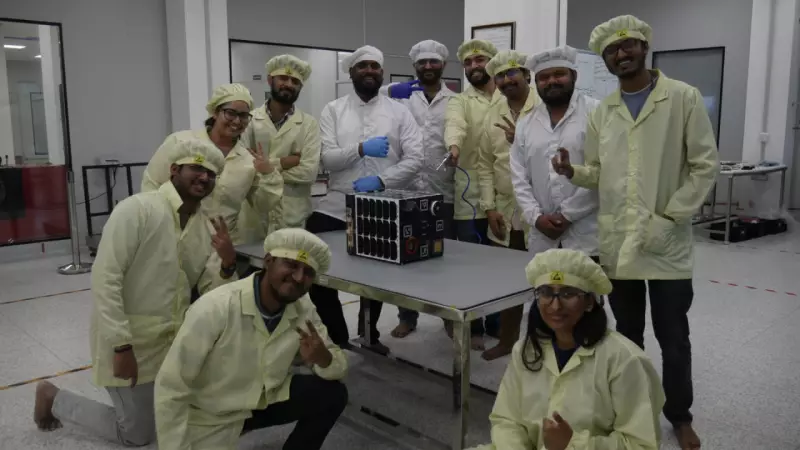
India is poised to take a giant leap in advanced space capabilities this Monday. When the Indian Space Research Organisation's (ISRO) PSLV-C62 rocket lifts off, it will carry a pioneering 25-kilogram satellite named Ayulsat, developed by the private startup OrbitAid. This mission is far more than a routine launch; it represents a critical step towards demonstrating a technology that could revolutionise satellite operations globally: on-orbit refuelling.
Aiming for an Exclusive Space Club
If the Ayulsat mission unfolds as planned, India will edge closer to becoming only the second country in the world to have proven this complex capability in space. To date, only China is believed to have conducted an on-orbit refuelling demonstration, though with limited public details. Notably, other major spacefaring nations, including the United States, have not yet publicly validated this technology in orbit. While US firm Astroscale is developing similar tech, it has not launched a demonstration mission.
It is crucial to clarify that Ayulsat's initial mission will not involve a full refuelling operation between two separate spacecraft. Instead, the satellite is engineered as a target vehicle to validate internal fuel transfer in the harsh environment of space. This first step focuses on moving fluids within a single satellite, allowing OrbitAid engineers to gather vital data on how propellants behave in microgravity under real orbital conditions—a foundational requirement for future, more complex servicing missions.

The Mission Profile and Rigorous Testing
In an exclusive discussion, OrbitAid's founder and CEO, Sakthikumar R, outlined the mission's ambitious timeline. The first refuelling operation is scheduled to occur within just four hours of launch. This will be followed by multiple refuelling cycles throughout the mission's duration. Sakthikumar explained that these transfers will be conducted under a variety of challenging conditions, including different thermal environments, pressure levels, and eclipse phases. The goal is to compile a comprehensive operational handbook for future, more advanced missions.
The path to this orbital demonstration has been one of meticulous preparation. OrbitAid spent several years conducting extensive ground tests and experiments in zero-gravity environments. The company performed high-pressure and low-pressure fluid transfer tests using propellants of varying viscosities. Crucially, subsequent zero-gravity tests conducted in the United States successfully achieved bubble-free fuel transfer, a non-negotiable requirement for safe and efficient refuelling in the vacuum of space.
Broader Implications and the Road Ahead
Beyond validating fuel transfer mechanics, the Ayulsat mission will also test OrbitAid's proprietary docking and refuelling interface. This hardware has been developed to support future in-orbit servicing and aligns with emerging international standards. Sakthikumar noted that the interface was designed in consultation with CONFERS, an industry-led consortium focused on establishing best practices for satellite rendezvous, proximity operations, and servicing.
The success of Ayulsat is set to trigger OrbitAid's next phase. The startup plans to launch a "chaser" satellite within six to eight months. That follow-up mission would demonstrate close-proximity operations, leading eventually to docking and fuel transfer between two separate spacecraft. This is the key step towards the ultimate goal: extending the operational lifespan of expensive satellites already in orbit.
The implications of mastering on-orbit refuelling are profound for both strategic and commercial space endeavours. This technology could:

- Drastically reduce the need for costly satellite replacements.
- Enable the recovery of spacecraft stranded in incorrect orbits.
- Allow missions, particularly for communication and Earth observation satellites, to continue for years beyond their designed fuel limits.
For India, this mission symbolises a significant shift in its space ecosystem. The fact that a cutting-edge capability like this is being flown by a private Indian startup highlights the growing prowess and ambition of the country's commercial space industry. As Sakthikumar succinctly put it, launching replacement satellites is prohibitively expensive, but servicing an existing one can dramatically alter the economics of space missions. The launch on January 12 will determine if India can secure its membership in one of the most exclusive clubs in modern spaceflight.





