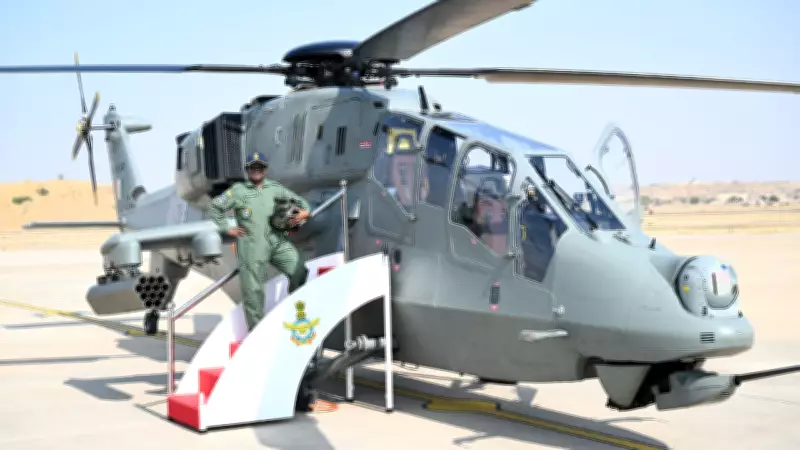
President Droupadi Murmu Makes History by Co-Piloting Indigenous HAL Light Combat Helicopter Prachanda
In a landmark event showcasing India's growing military self-reliance, President Droupadi Murmu on Friday became the first President of India to co-pilot the indigenously-developed HAL Light Combat Helicopter 'Prachanda'. The historic flight took off from the Jaisalmer air force station, marking a significant moment for the nation's defense capabilities.
Presidential Flight and Aerial Salute to the Nation
At precisely 9:45 am, President Murmu embarked on a roughly 25-minute sortie in a two-aircraft LCH formation. She occupied the lead helicopter alongside Group Captain Nayan Shantilal Bahua, while Air Chief Marshal A P Singh flew in the second LCH with Group Captain A Mahendra. The formation provided an aerial view of critical border areas and the expansive Pokhran range.
During the flight, President Murmu delivered an inspiring address via radio, stating: "The Prachand helicopter is a powerful symbol of self-reliance. I am currently flying over the famous fort of Jaisalmer. I proudly thank the brave soldiers of the country. My loving Namaskar to everyone. Jai Hind, Jai Bharat." She was seen saluting and giving a thumbs-up gesture, demonstrating her support for the armed forces.

This achievement adds to President Murmu's pioneering aviation record, having previously become the first President to fly in advanced fighter jets including the Sukhoi Su-30MKI and Rafale aircraft.
Vayu Shakti: A Spectacular Display of Air Power
Following the presidential flight, President Murmu, accompanied by Defence Minister Rajnath Singh, IAF Chief Air Marshal A P Singh, Rajasthan Governor Haribhau Bagade, and Union Minister Gajendra Singh Shekhawat, witnessed the Indian Air Force's formidable firepower demonstration. The 'Vayu Shakti' exercise unfolded at the Pokhran range near the Pakistan border, showcasing the IAF's operational readiness and strategic capabilities.
The day-dusk-night demonstration in the Thar desert featured a comprehensive presentation on Operation Sindoor at the beginning, followed by detailed displays across a 3-kilometer area. Simulated targets included:
- An enemy runway and petroleum storage facility
- Bunkers and radar sites
- Tank and armored convoys
- A communication center and terror camp
- Ammunition storage, hangar, and command-and-control center
Coordinated Aerial Operations and Strategic Demonstrations
The exercise featured meticulously synchronized operations by fighter jets and attack helicopters, displaying advanced strategy formulation, precise target identification, and calibrated destruction capabilities. The IAF demonstrated a controlled escalation response and precision strikes as part of the simulated mission.
Jaguar and Mirage fighter aircraft executed simultaneous strikes on designated targets, replicating coordinated attack patterns demonstrated during Operation Sindoor. A Sukhoi fighter aircraft conducted a strike on a simulated terror camp, while suppression and destruction of enemy air defense systems were showcased to neutralize hostile capabilities.
The coordinated operations saw participation from Apache helicopters, Mirage jets, and Mi-17 V5 helicopters, creating a comprehensive display of India's multi-platform combat readiness.
Historic S-400 Missile System Revelation
Hours before the Vayu Shakti exercise, the Indian Air Force made history by releasing the first-ever video showcasing the Sudarshan S-400 long-range air defense missile system in operational deployment. This rare glimpse offered unprecedented insight into one of India's most advanced and closely-guarded military assets, which played a crucial role in Operation Sindoor.
The video caption referenced a historic interception event, highlighting a successful strike on a target approximately 314 kilometers deep inside Pakistani territory last May. Overlay text in the IAF video proclaimed: "Longest-ever kill recorded in military history" and "Enemy may be out of sight but never out of reach," underscoring the system's formidable capabilities and strategic significance.

This comprehensive demonstration of India's aerial prowess and indigenous defense technology development represents a significant milestone in the nation's journey toward military self-sufficiency and strategic deterrence capabilities.