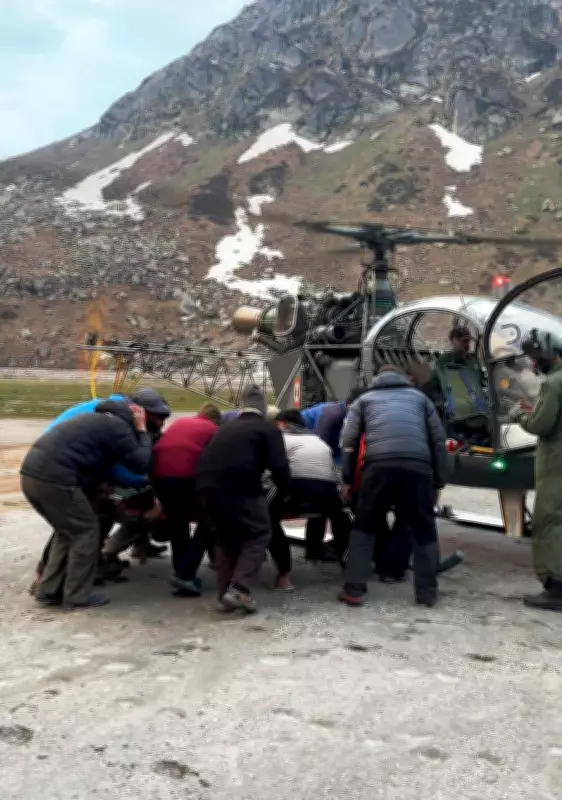
NCC Team Turns Rescue Mission in High-Altitude Operation
The Kullu National Cadet Corps (NCC) Mount Deo Tibba expedition team rescued critically injured British cinematographer George Richmond after his paraglider crashed in the Deo Tibba region near Manali on June 8. Wing Commander Kunal Bhardwaj, Commanding Officer of 1 HP Air Squadron NCC, Kullu, stated that a mountaineering expedition turned into a humanitarian rescue mission upon receiving news of the accident.
“Our team had just reached the advance base camp after an arduous climb through difficult terrain while carrying expedition loads. We were preparing to rest when news arrived through a Motorola radio set that a foreign paraglider had suffered serious head, neck and spinal injuries near Tenta Base Camp,” Bhardwaj said.
Rescue Team Braves Extreme Conditions
Despite physical exhaustion, rapidly changing weather, steep gradients and glaciated terrain, a rescue team comprising Cadet Jitender, Cadet Vibhor, medical attendant Chaman and Atal Bihari Vajpayee Institute of Mountaineering and Allied Sports instructors Deshraj and Gimnar immediately set out for the accident site. They carried medical supplies, oxygen cylinders and communication equipment, descending rapidly to reach the injured paraglider.

Richmond, an internationally acclaimed cinematographer associated with several Hollywood productions, was reportedly filming in the region along with British actor Dominic West when the accident occurred. Upon reaching the site, the rescue team administered first aid, stabilised his condition and maintained constant communication with medical experts while assessing evacuation options.
IAF Evacuation Amid Deteriorating Weather
Recognising the seriousness of the injuries, Wing Commander Bhardwaj initiated emergency air evacuation procedures. However, worsening weather, poor visibility and increasing fog made helicopter operations extremely difficult, with several private operators declining the mission. “At this critical stage, the Indian Air Force stepped forward. Earlier aerial reconnaissance of the route proved invaluable. I remained in constant contact with Sarsawa Air Force Station through a satellite phone while communication relays were established through our advance base camp,” Bhardwaj said.
The team identified and prepared a suitable landing zone, established communication with the aircrew and guided the helicopter to the extraction point despite adverse conditions. Working against time and deteriorating visibility, the Indian Air Force successfully evacuated Richmond to Kullu before nightfall. Following the evacuation, the rescue team undertook a difficult return journey through the mountains after dark.
NCC Values on Display
Bhardwaj described the operation as a shining example of the NCC’s values of discipline, courage, teamwork and selfless service. “What began as a mountaineering expedition became a life-saving mission and will remain a proud chapter in NCC history,” he said.