

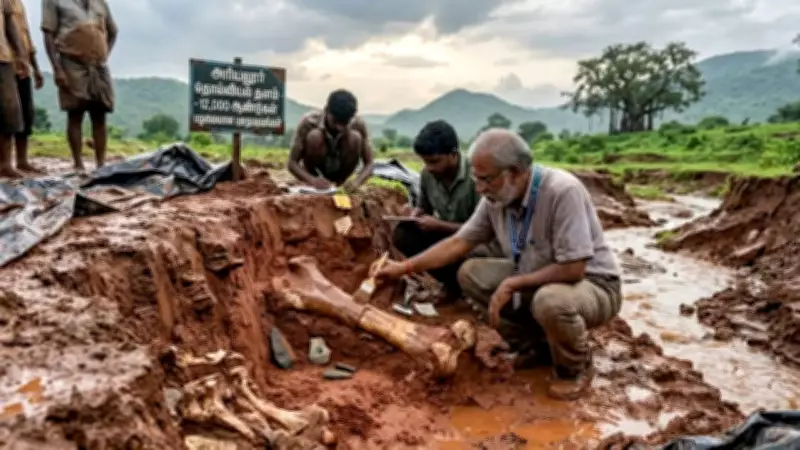
In the Thoothukudi district of Tamil Nadu, India, heavy rains caused substantial soil erosion, exposing an ancient fossil bed approximately 12,000 years old. Union Environment Minister Bhupender Yadav confirmed the site belongs to the Holocene Epoch, a critical transitional period for modern ecosystems and early human development.
Discovery and Significance
At the request of local government bodies, the Zoological Survey of India (ZSI) conducted a comprehensive field survey, confirming that the deposits represent a major addition to India's Quaternary record. These fossils provide a natural archive of ancient biodiversity, climate change, and environmental conditions in Southern India.
Fossil Analysis and Insights
The exposure contains marine invertebrate fossils such as molluscs, gastropods, and bivalves within ancient sedimentary formations. Researchers aim to analyze fossil composition to determine past vegetation types—forests or grasslands—and whether the area was once a marine environment. This data will fill gaps in the southern Indian fossil record.

Geological Context
The Quaternary Period, spanning the last 2.6 million years, is marked by dynamic climatic shifts. The Thoothukudi site offers a high-resolution window into Holocene sedimentology. Geologists study preserved structures like cross-stratification (current-formed layers) and bioturbation (burrowing evidence) to reconstruct ancient coastal dynamics.
Conservation Urgency
Because the fossils are exposed to natural erosion, their integrity is at risk. Experts urge immediate conservation protocols to prevent degradation before thorough longitudinal studies can be completed.
Human Civilization and Climate
The Holocene Epoch spans about 11,700 years, coinciding with late and post-Stone Age human civilization. Researchers use such records to trace monsoonal variations—Southwest and Northeast monsoons—that influenced ancient regional civilizations. This discovery provides a calibrated chronological framework linking paleontological findings with environmental changes, offering a clearer picture of the region's ancient past.






