

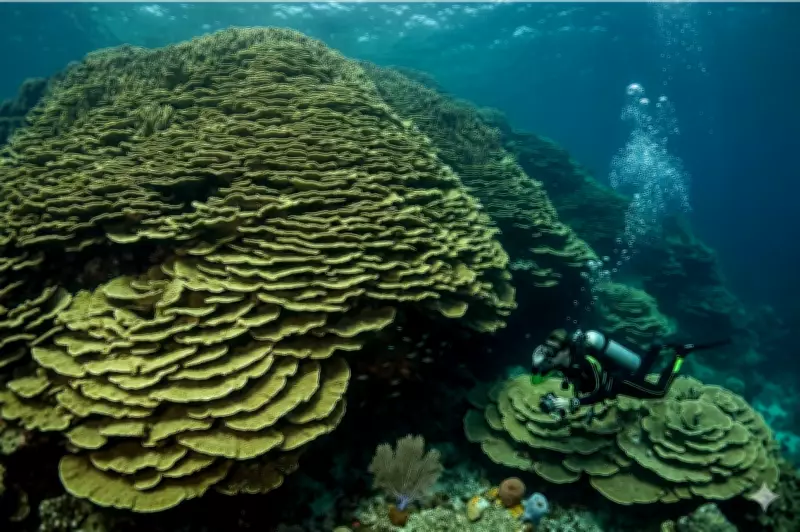
Imagine three NBA basketball courts, side by side, at the bottom of the sea. Now, imagine that whole surface is one living coral colony, one that was already 500 years old when the Roman Empire fell. That is what a team of NOAA researchers found on a 2025 survey in the Mariana Islands, about 450 miles north of Guam. The coral, a species called Porites rus, is more than 100 feet tall and about 200 feet wide at its base, covering some 14,500 square feet. It is the largest Porites coral ever found, approximately 3.4 times the size of the former record holder, which was discovered in American Samoa in 2020.
Living in a Volcano Underneath the Sea
This record-breaking coral does not live in some pristine, protected reef. It lives in the caldera of an active underwater volcano in the Maug Islands, where carbon dioxide vents bubble up vigorously from the seafloor. Those vents make the water around them acidic, the same kind of chemistry that is threatening reefs worldwide as our oceans take in more carbon dioxide from the atmosphere. Except here, it is happening naturally, in a concentrated area, and just a few hundred yards away, this ancient coral is thriving. NOAA National Ocean Service calls the site a natural laboratory, and it is not hard to see why. In this same stretch of water, you will find a dead zone near the vents and an over 2,000-year-old megacoral living a short swim away. Scientists can study the two side by side and see what the real difference is.
Why This Matters More Than Just a Cool Record
Let us be honest about where reefs are at this moment, because the context is sobering. NOAA data show that the third global coral bleaching event from 2014 to 2017 brought dangerous heat stress to more than 75 percent of reefs worldwide. Nearly 3 in 10 were in conditions severe enough to lead to mass die-offs. Specifically in the Mariana Islands, the area has lost approximately half its coral cover over the past two decades. The discovery was made during a routine health check of the ocean, which has also documented heavy losses in the same waters. A researcher swims in front of the massive coral, a structure so large that scientists could not fully measure it due to dive safety restrictions. So this coral is not a proof that everything is alright. It is more like a question mark. What does this particular colony know that the rest do not? What combination of depth, water movement, genetics, or simply luck kept it alive for two millennia through storms, temperature changes, and now rising ocean acidity?

The Age Is an Estimate, but It Is Still Staggering
No one has yet taken a core sample, which would give a more precise age. Porites rus does not lay down clean growth rings as some corals do, so there is no easy way to count the years. Instead, researchers work backwards using a rough growth rate of 0.4 inches a year. That math puts the coral may be more than 2,050 years old. Around 25 BCE, give or take a century, something began to grow on that seafloor, and it never stopped. For scale: that predates the founding of Christianity, the fall of the Roman Republic, and every major empire most Americans learned about in high school.
What Happens Next
It is found within the Mariana Trench Marine National Monument, created in 2009, so it has some legal protection. NOAA says an advisory council is working on a culturally appropriate name to honour the indigenous Chamorro and Carolinian communities of the region. Beyond the name, the real work is to figure out what this coral can teach us. If scientists can understand what makes this colony so resilient, it could directly inform how conservationists approach reef protection globally, including reefs off Florida and Hawaii that Americans interact with every year. Coastal communities have a lot at stake. The value of U.S. coral reefs for risk reduction, according to U.S. Geological Survey (USGS) data, is massive in both economic and physical terms. U.S. coral reefs provide an estimated economic value of more than $3.4 billion annually, according to the USGS and NOAA. Reefs can absorb up to 97 percent of wave energy, serving as essential barriers that shield coastal infrastructure and communities from storm damage and erosion. This coral has lived for 20 centuries. At the very least, we can work out how, and whether we can learn from it, before other reefs lose the chance.






