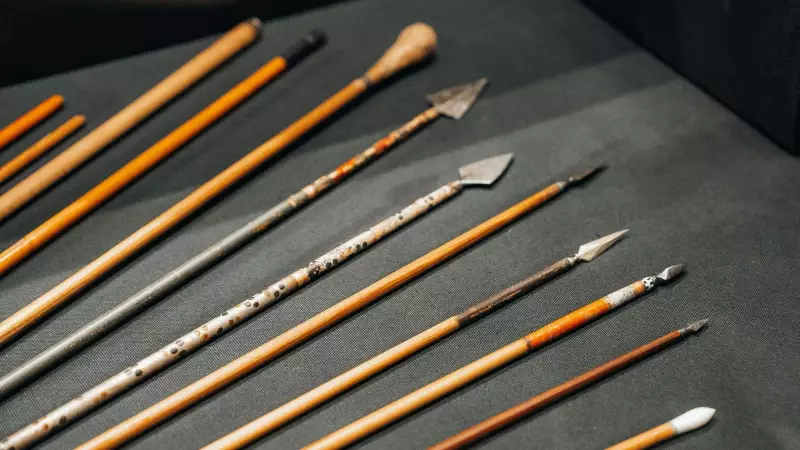
New scientific analysis has uncovered a startling chapter in human prehistory, revealing that our ancestors in Africa were crafting and using poison-tipped arrows a staggering 60,000 years ago. This discovery, made by examining ancient artefacts from South Africa, pushes back the timeline for the use of biochemical weapons by tens of thousands of years, showcasing a level of sophistication far earlier than previously imagined.
Chemical Traces on Ancient Arrowheads
The breakthrough came when a research team led by Marlize Lombard from the University of Johannesburg re-examined quartzite arrow tips excavated decades ago from the Umhlatuzana rock shelter in KwaZulu-Natal, South Africa. Using modern analytical techniques on artefacts first discovered in 1985, scientists found definitive chemical evidence that had eluded them before.
On five out of ten artefacts studied, researchers identified traces of toxic plant alkaloids, specifically buprenorphine and epibuphanisine. The most likely source of these potent chemicals is Boophone disticha, a plant native to southern Africa known for its milky, toxin-rich sap. The consistent presence of these compounds across multiple tools strongly indicates intentional application, not accidental contamination.

A Technological Tradition Spanning Millennia
This finding resolves a long-standing uncertainty. While stone and bone points from 50,000 to 80,000 years ago had shapes suggesting poison use, and one 60,000-year-old point was found with a sticky residue, definitive proof of poison was missing until now. The research suggests early hunters processed the plant sap, possibly by heating and drying it, then mixing it with other materials to create a durable resin that would adhere to their weapon tips.
Lombard posits that this knowledge represents one of the longest continuous technological traditions known, potentially stretching back uninterrupted for 60,000 years. The use of Boophone-based poisons is well-documented among San communities in southern Africa into modern times, creating a direct link to this ancient practice.
Implications for Understanding Early Human Cognition
The discovery paints a far more complex picture of early human behaviour and ecological knowledge. Sven Isaksson of Stockholm University, a team member, emphasised that while using plants for food or basic tools is common, exploiting their biochemical properties for poison marks a significant cognitive leap. This represents a deliberate manipulation of the natural environment for strategic advantage.
The toxins from Boophone disticha are powerful enough to kill small animals within minutes and can induce nausea, coma, or death in humans. For hunting large game, the poison may not have caused immediate death but would have severely weakened the animal, allowing hunters to track and finish it over long distances—a highly efficient hunting strategy.
Researchers believe the plant's toxic properties were discovered through trial and error, possibly after people consumed the bulbs and fell ill. The plant is also known for its preservative, antibacterial, and hallucinogenic effects and remains used in traditional medicine today. To corroborate their findings, the team also analysed 18th-century arrows collected by Swedish naturalist Carl Peter Thunberg, confirming the presence of the same Boophone-derived compounds used by Indigenous hunters.
This landmark study, published in a peer-reviewed journal, fundamentally alters our understanding of prehistoric innovation. It reveals that early humans in Africa possessed not only sophisticated tool-making skills but also a deep, applied knowledge of plant chemistry, harnessing nature's toxins for survival tens of thousands of years before the advent of recorded history.