

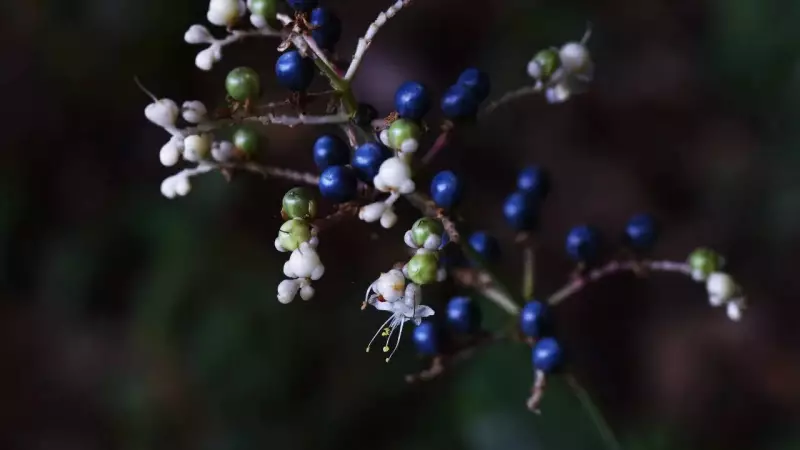
In the lush, shaded undergrowth of tropical African forests, a small, hard fruit challenges one of nature's fundamental rules. The Pollia condensata berry displays an intense, shimmering metallic blue, a colour so rare in the plant kingdom that it captivates at first glance. Yet, this vibrant hue contains no blue pigment at all. Its secret lies not in chemistry, but in physics, making it a subject of intense study for biologists, physicists, and material scientists worldwide.
The Science Behind the Shimmer: How Structure Creates Colour
Unlike most plants that rely on chemical pigments to produce colour, the Pollia condensata achieves its stunning appearance through a phenomenon known as structural colour. The skin of the fruit is engineered with microscopic, helicoidal layers of cellulose. These intricate structures act like a natural diffraction grating, manipulating incoming light. Through a process of interference, they reflect specific wavelengths—primarily in the blue spectrum—while cancelling out others. This physical manipulation of light creates a far more vivid and metallic effect than any pigment could achieve.
Each individual cell in the fruit's skin reflects a slightly different shade of blue due to minute variations in the thickness and twist of these cellulose layers. This creates a dazzling pointillist or mosaic pattern, similar to the technique used by painters, which collectively enhances the berry's overall brightness and visual complexity. Research published in the Proceedings of the National Academy of Sciences confirmed the extraordinary efficiency of this system. The reflected light is so potent that the fruit retains its striking, metallic vividness for decades, even after it has completely dried out.

An Ecological Strategy: Beauty Without a Food Reward
Native to specific regions of tropical Africa, the Pollia condensata is an ecological puzzle. The berry itself is hard, offers minimal pulp, and provides almost no nutritional value to animals. So why evolve such a conspicuous, long-lasting colour? Scientists believe its brilliance is a clever evolutionary adaptation for seed dispersal. In the dense, competitive environment of a tropical forest floor, standing out is crucial.
The berry's persistent, metallic blue acts as a powerful visual signal for birds and other animals. Attracted by the shimmer, animals may collect the fruit for nest decoration or display, inadvertently carrying and dispersing the seeds in the process. This strategy gives the plant a significant advantage: its seeds can be spread over time by multiple visitors, all without the metabolic cost of producing sugary, fleshy fruit or chemical pigments. It's a masterclass in efficient, visual communication within an ecosystem.
Inspiring the Future: From Forest Floor to Lab Bench
The implications of this tiny berry extend far beyond botany and ecology. For evolutionary biologists, it demonstrates how plants can develop durable, attention-grabbing signals without the high energy expenditure of pigments or sugars. The longevity of its colour ensures a wide dispersal window, a key adaptive trait.
For physicists and material scientists, Pollia condensata is a blueprint for innovation. Its helicoidal cellulose structures are inspiring cutting-edge biomimetic research. Engineers are actively exploring ways to replicate this pointillist, structural colour to create vivid, non-toxic, and fade-resistant colours for textiles, coatings, paints, and sustainable packaging. This pursuit offers a potential green alternative to traditional chemical dyes, showcasing how nature's designs can solve human technological challenges.
Ongoing studies continue to probe how slight variations in the berry's nano-architecture affect its optical properties and whether related species use similar mechanisms. This interdisciplinary research, bridging botany, optics, and material science, underscores the sophistication of natural engineering. The Pollia condensata stands as a powerful reminder that some of the most brilliant solutions are often found not in a lab, but in the timeless ingenuity of the natural world.

